
A 5.10% U.S. yield and a UN warning put debt stress on screen
Higher U.S. borrowing costs and a firm dollar can turn policy warnings into refinancing tests for weaker borrowers.
 Odile MarchettiCentral banks, rates and sovereign debt
The U.S. 10-year Treasury yield was 5.10% on 15 October, above the 4.77% two-year yield and the 3.88% effective federal funds rate. The United Nations has warned of a new debt crisis and said debt interest costs are running out of control, while Tunisia’s hardship is described as deepening. SBI and five other banks are reported to have raised home-loan rates, and the broad dollar index was 121.6023 on 9 October.
On 15 October, the U.S. 10-year Treasury yield stood at 5.10%, 33 basis points above the two-year note and 122 basis points above the effective federal funds rate. That is an upward-sloping curve, not an inverted one, and it does not by itself prove a global debt crisis. But it changes the price of waiting.
The two-year yield was 4.77% on the same day, while the effective federal funds rate was 3.88%. The short end is therefore above the policy rate, and the long end is above the short end. In plain terms, money is not merely expensive today; it is priced to remain expensive for years, unless the market is wrong.
The broad dollar index was 121.6023 on 9 October. A firm dollar can reflect demand for dollar assets, but it also tightens conditions for borrowers whose revenues are not in dollars. The index alone does not say which force is dominant. It does say that the currency side of the financing problem has not gone away. A warning is not a price, but a higher risk-free curve changes every price built on it.

A steep curve is not a verdict
The shape is consistent with several forces. An upward-sloping curve can sit comfortably with growth, inflation expectations or a higher term premium. It can also sit with a market that demands more compensation for lending far into the future.
A warning is not a price, but a higher risk-free curve changes every price built on it.
For sovereigns and companies that need to refinance, the difference matters less than the direction. A benchmark that stays high raises the coupon on new debt, raises the hurdle for rolling old debt, and gives lenders more leverage over weaker borrowers. The stress is not necessarily sudden. It can arrive as a slower drip: a higher reset, a narrower covenant, a postponed issuance.
The United Nations has warned of a new debt crisis and said that debt interest costs are running out of control. That is a policy voice, not a market price. A warning can be right before markets agree, or it can be right about hardship without being right about contagion. The point is that the alarm is now being sounded while the U.S. curve is still elevated, not after it has fallen.
Banks and households feel it first
The transmission is easier to see where loans are repriced quickly. SBI and five other banks are reported to have raised home-loan interest rates. That is not exotic finance. It is the ordinary machinery of monetary policy moving from policy settings to monthly payments.
For households, the channel is direct: a higher loan rate means a higher instalment, less disposable income, and less room to absorb shocks. For banks, higher lending rates can protect margins, but they can also thin demand and raise the risk that borrowers struggle. The same move can look like pricing power on one side of the balance sheet and credit risk on the other.
Tunisia’s economic crisis is described as deepening, with joblessness, failing services and rising costs increasing hardship. A single stressed economy does not make a global crisis. But it shows what happens when fiscal strain, weak services and high financing costs land on the same population at once. The warning is macro; the experience is household-level.
What would make this systemic
The missing piece is behaviour. Higher U.S. yields, a firm dollar and official warnings become a systemic story only if they change what investors and lenders do: if they refuse rollovers, demand much higher spreads, or force asset sales. Nothing in these numbers proves that has happened.
The open question is whether the current configuration is a stable high-rate equilibrium or the beginning of a refinancing test. The 10-year yield at 5.10% says long-dated U.S. debt is being paid well to be held. The dollar index at 121.6023 says the currency is not weakening to ease the pressure. The UN warning says the policy community is worried about interest costs. The next signal will come from whether more banks, more sovereigns and more borrowers start to show strain in actual payments, not just in speeches.
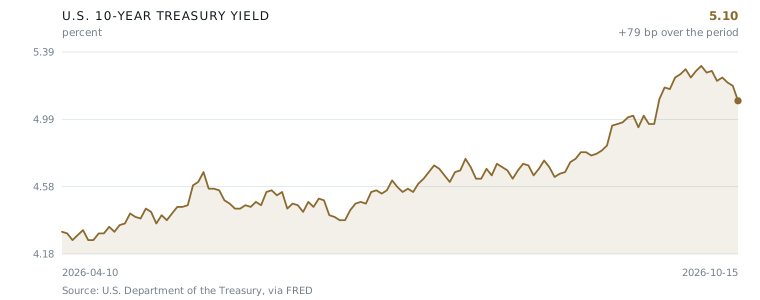
- 01U.S. 10-year Treasury yield was 5.10% on 15 October.
- 02U.S. 2-year yield was 4.77%; effective federal funds rate was 3.88%.
- 03Broad dollar index was 121.6023 on 9 October.
- 04The United Nations warned of a new debt crisis and said interest costs are running out of control.
- 05SBI and five other banks are reported to have raised home-loan rates; Tunisia’s crisis is described as deepening.
Interpretation, not reporting. The facts above carry their tiers; this is one correspondent’s reading of them.
The market is not flashing a panic signal; it is setting a refinancing trap. The U.S. 10-year yield at 5.10% and the two-year at 4.77% show that investors are being paid to wait, but they are also being asked to wait through a policy rate that stood at 3.88%. I read that combination as pressure rather than rupture. The dollar index at 121.6023 adds a currency burden for non-dollar revenues, while the United Nations warning and the reported home-loan rate increases at SBI and five other banks show how quickly macro conditions can reach households. Tunisia’s described hardship is the clearest human example, but one economy does not make a global event. What would change my mind is not another speech. It would be evidence that higher yields and a firm dollar are forcing missed payments, rollovers on punitive terms, or a broad retreat from weaker credit. Until then, I treat this as a stress test being priced, not a crisis being confirmed.
— Odile Marchetti
Every claim in this article, and what it rests on
We do not ask you to take our word for it. Each statement below carries its tier and its sources. Where sources disagree, you get both accounts and what would settle it.
The U.S. 10-year Treasury yield was 5.10% on 2026-10-15.
The U.S. 2-year Treasury yield was 4.77% on 2026-10-15.
The effective federal funds rate was 3.88% on 2026-10-15.
The broad dollar index was 121.6023 on 2026-10-09.
The United Nations warned of a new debt crisis.
The United Nations warning said debt interest costs are running out of control.
SBI and five other banks raised home-loan interest rates.
Tunisia’s economic crisis is deepening as joblessness, failing services and rising costs increase hardship.
The case against this story
Written by an adversarial reviewer, not the correspondent
The story bolts a UN warning, a Tunisian hardship summary, and one cluster of bank rate hikes onto U.S. yield data, but the data do not prove a global debt crisis. A 10-year Treasury yield at 5.10% and a 2-year yield at 4.77% with the effective federal funds rate at 3.88% is an upward-sloping curve, consistent with growth, inflation expectations, or term premium as much as distress. A broad dollar index at 121.6023 can reflect demand for dollar assets, not a breakdown. Tunisia is a single stressed economy, and banks raising home-loan rates can be routine monetary-policy transmission. The UN warning is a policy voice, not market consensus.
Who benefits from this framing: Lenders that raised home-loan rates benefit if borrowers accept the hikes as an unavoidable market condition. Holders and sellers of dollar or Treasury safe-haven products benefit from inflows. Investors short emerging-market or Tunisian debt benefit from crisis framing. Advocates of austerity, debt relief, or official-sector intervention benefit because the framing supports their policy asks.
Report an error in this article
Subscriptions open at launch
Global Wealth Review will be a paid publication. Reading is free while we build the archive — leave an address and we will write to you once, when subscriptions open.