
A HK$80 million shop sale is not a capital crisis
Three reported fragments from property, wealth products and equities are being read as Hong Kong stress, but each lacks the context needed to judge capital flows.
 Odile MarchettiCentral banks, rates and sovereign debt

A reported HK$80 million Causeway Bay shop sale, a reported low-threshold HSBC wealth product and a yuan-equity slump have been bundled into a story about Hong Kong’s capital outlook. The only firm rate point is the US two-year Treasury yield at 4.79% on 13 October. Missing benchmarks, inflation details and property data make the stress narrative hard to verify.
On 13 October, the US two-year Treasury yield stood at 4.79%. Around that same window, three items from Hong Kong began circulating together: a reported HK$80 million sale of a Causeway Bay street shop by Jardine Matheson, HSBC’s reported launch of a retail discretionary portfolio-management service with a minimum as low as HK$1,000, and a slump in mainland Chinese and Hong Kong stocks on Thursday. Read together, they have been framed as a stress test for the city’s capital outlook. Read separately, they are thinner.
A shop sale is a price, not a market
The property item is the most concrete. Jardine Matheson is reported to have sold a street shop in Causeway Bay for HK$80 million, and the transaction is described as occurring amid a downturn in Hong Kong’s commercial property market. That may be true, but a single sale establishes only one clearing price. It does not show the depth, breadth or duration of a decline. To move from one shop to a market-wide repricing, an allocator would need transaction volumes, rental trends, vacancy data and financing conditions. None of those appear here.
The channel through which property stress would matter is clear. Lower transaction values can erode collateral marks, tighten credit against real estate and weigh on consumption-linked landlords. But the evidence here stops at one address and one price. A sale in a famous shopping district can anchor expectations, yet it can also reflect a specific seller, a specific tenant mix or a specific financing deadline.
A HK$1,000 minimum changes distribution, not risk
HSBC is reported to have launched a discretionary portfolio-management service for retail investors, with a minimum investment threshold as low as HK$1,000, or US$128. If those terms are accurate, the significance is distribution. A wealth manager that once served larger balances is now reaching much smaller accounts, turning savings into managed products at a lower cost of entry. That can deepen fee income and keep client money inside the bank’s ecosystem.
The figure is also unusually low for discretionary portfolio management, so the exact wrapper, fees and mandate matter. It may be a simplified portfolio, a fund-based mandate or a promotional tier rather than a bespoke account. Without those details, the launch says more about product packaging than about investor demand. In a market worried about capital outflows, a bank pushing lower thresholds may be trying to mobilise local savings rather than rely on large cross-border flows.
The equity and rate numbers need their missing context
Equities provide the third thread. Stocks in mainland China and Hong Kong slumped on Thursday, and a benchmark of yuan-denominated equities is said to have slid to a 14-month low. The problem is the missing noun: which benchmark? A 14-month low in one yuan-denominated index can be meaningful, but it can also be selected from a narrow segment, while broader indices may have behaved differently.
US inflation is invoked in the same way. A hot reading is said to have spurred concerns about Federal Reserve tightening, but no CPI figure, release date or comparison with expectations is supplied. That leaves the rate point isolated. The US two-year Treasury yield was 4.79% on 13 October. That is a hard number, but without the prior day, the month’s range or the expected path of policy, it cannot show whether markets were repricing risk or merely trading a routine session.
For Hong Kong, short US rates can feed funding costs and asset appetite. That transmission matters when investors are already weighing property and equity weakness. But the available evidence does not yet show a funding squeeze. It shows a level, not a move.
The open question is whether these fragments are early evidence of a broader repricing or simply unrelated items arranged into a cautionary tale. The next test will come from repeatable data: more property transactions, a named equity benchmark, the actual inflation print and a trend in two-year yields.
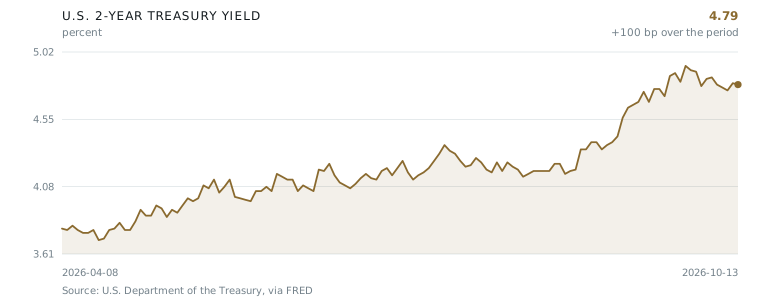
- 01The US two-year Treasury yield was 4.79% on 13 October.
- 02Jardine Matheson is reported to have sold a Causeway Bay street shop for HK$80 million.
- 03HSBC is reported to have launched retail discretionary portfolio management with a minimum as low as HK$1,000.
- 04Mainland China and Hong Kong stocks slumped on Thursday, and a yuan-denominated equity benchmark is said to have hit a 14-month low.
- 05A hot US inflation reading is said to have raised Federal Reserve tightening concerns, without the actual figure.
Interpretation, not reporting. The facts above carry their tiers; this is one correspondent’s reading of them.
The fragments add up to distribution pressure, not confirmed distress. I see a bank trying to widen its retail funnel, a single property trade, and an equity move missing its benchmark. That is not a capital flight thesis. The rate point is real but naked: 4.79% on the two-year Treasury on 13 October tells me little without the prior week and the inflation print that supposedly moved it. If the unnamed yuan-denominated index is a broad, investable gauge, if the HK$1,000 minimum is a genuine discretionary mandate rather than a simplified fund wrapper, and if property transactions follow the Causeway Bay price lower through the quarter, I would treat this as the start of a repricing. If not, it is three separate stories: a sale, a product launch and a nervous equity session. The more useful question is who is being asked to supply the next marginal dollar: global allocators, mainland investors, or local savers with small balances. That answer will determine whether Hong Kong’s hub is shrinking or merely retailing its way through a wobble.
— Odile Marchetti
Every claim in this article, and what it rests on
We do not ask you to take our word for it. Each statement below carries its tier and its sources. Where sources disagree, you get both accounts and what would settle it.
The US 2-year Treasury yield was 4.79% on 2026-10-13.
Jardine Matheson sold a street shop in Causeway Bay for HK$80 million.
The sale occurred amid a downturn in Hong Kong’s commercial property market.
HSBC launched a discretionary portfolio-management service for retail investors.
HSBC’s retail discretionary portfolio-management service has a minimum investment threshold as low as HK$1,000 (US$128).
Stocks in mainland China and Hong Kong slumped on Thursday.
A benchmark of yuan-denominated equities slid to a 14-month low.
A hot US inflation reading spurred concerns about Federal Reserve tightening.
The case against this story
Written by an adversarial reviewer, not the correspondent
The story stitches together loosely related events into a narrative of broad market distress, but the connections are weak. A single property sale — even if correctly attributed — does not establish a market downturn; one transaction is anecdote, not trend. The claim that HSBC launched discretionary portfolio management with a HK$1,000 minimum is implausibly low for that product type and likely mischaracterizes a different offering. The unspecified 'benchmark' of yuan-denominated equities sliding to a 14-month low cannot be verified without knowing which index is referenced and could be cherry-picked from among many. The US inflation reading is invoked without the actual CPI figure, release date, or comparison to expectations. The only hard data point — the 2-year Treasury yield at 4.79% — is presented without prior-day context or trend, making it impossible to assess whether it represents a meaningful move or routine fluctuation. Taken individually, each claim is either vague, unverifiable, or potentially misreported; the narrative only appears coherent because the items are placed side by side.
Who benefits from this framing: Short-sellers and bearish traders in Hong Kong and mainland Chinese equities benefit from a narrative of market distress that could pressure sentiment and accelerate selling. HSBC benefits from free publicity for its new retail product, especially if the implausibly low minimum threshold attracts attention without scrutiny. Distressed-property buyers benefit if the Hong Kong commercial property downturn framing makes sellers more willing to accept lower prices. Parties with short positions in US Treasuries benefit from the framing of hot inflation and Fed tightening, which supports higher yields. Readers who act on this framing without verifying the specific claims risk making investment decisions based on a narrative constructed from vague and potentially misreported data points.
Report an error in this article
Subscriptions open at launch
Global Wealth Review will be a paid publication. Reading is free while we build the archive — leave an address and we will write to you once, when subscriptions open.