
A steep curve and war risk favor dividends and gold over Bitcoin
The 10-year at 5.10% is doing more work than the policy rate, changing the trade-off between carry, hedges and crypto.
 Odile MarchettiCentral banks, rates and sovereign debt

On 15 October, the 10-year Treasury yielded 5.10%, the two-year yielded 4.77%, and the effective federal funds rate was 3.88%. That steep gap makes income and hedges more competitive than speculative upside. Market commentary pointed to dividend stocks, gold and a capped Bitcoin, but the underlying evidence varies in precision.
On 15 October, the U.S. 10-year Treasury yield stood at 5.10%, while the effective federal funds rate was 3.88%. That is a gap of 122 basis points. The two-year yield was 4.77%, or 89 basis points above the policy rate, and SOFR was 3.89%. The long end, not the overnight rate, is doing the disciplining.
This matters because allocation debates often flatten all rates into one. A fund manager comparing Bitcoin to cash looks at one number. A fund manager comparing Bitcoin to a 10-year bond looks at another. At 5.10%, a long-dated government bond offers a nominal carry that competes directly with scarce risk premia. That changes the hurdle for assets whose main promise is future appreciation.
The long bond is the constraint
The curve is not merely high; it is steep. The two-year at 4.77% says short-term funding is no longer at the policy rate alone. The 10-year at 5.10% says investors demand more term premium for duration. If the market is pricing higher-for-longer yields, the pressure on risk assets comes through discount rates and portfolio competition.
The mechanism is simple. A higher 10-year yield lowers the present value of distant cash flows. It also gives conservative portfolios a usable income stream. For an allocator, that means a dividend or coupon can replace part of the exposure that once went to more speculative assets. The trade is not emotional. It is arithmetic.
The long end, not the overnight rate, is doing the disciplining.
This is where the phrase “rising interest rates” needs care. The effective federal funds rate at 3.88% is not, by itself, a tightening number. The pressure comes from longer maturities. A steep curve can sit alongside market turmoil if investors demand compensation for holding duration. That is the tension in the current tape.
Dividends and gold get the defensive bid
The reported response is a move toward income and hard hedges. Chinese investors are said to be moving into dividend stocks to shelter from market turmoil. One figure in circulation says dividend stocks have delivered returns double those of state bonds, though no index or period is specified. That is the kind of number that needs a denominator before it becomes a portfolio argument.
Gold has a clearer role. It is a non-yielding asset, but it is also a political and currency hedge. Guotou Securities is cited as saying gold is showing an obvious bottom signal. The phrase is strong, but a bottom call is not a balance-sheet fact. It becomes more persuasive only if actual buying confirms it.
Still, the logic is familiar. When long yields are high, gold must fight the opportunity cost of carry. When war risk rises, gold can regain a bid as insurance. The two forces pull in opposite directions. That is why gold often stops behaving like a simple risk asset and starts behaving like a contingency.
Bitcoin’s ceiling is a rates and war story
The crypto argument is more conditional. The bearish case is that Bitcoin is unlikely to break above US$100,000 before the end of the year while rising interest rates and the Iran conflict continue. It also says Bitcoin faces a real risk of further sharp pullbacks. Put together, this is a story about a capped upside and a fat left tail.
The rate channel works through liquidity. Expensive long money reduces the marginal bid for high-volatility assets. It also makes hedging and carry more attractive than directional risk. The war channel works through risk appetite. Conflict can produce sudden de-risking, wider spreads and a preference for settlement assets.
But the comparison has limits. Bitcoin is not a duration asset in the way a long bond is. It can trade like a liquidity proxy, a currency hedge or a speculative position depending on the buyer. A ceiling at US$100,000 is therefore not a mechanical outcome from a 5.10% 10-year yield. It is a market call that assumes the same buyers remain sensitive to rates and headlines.
The open question is which force dominates. If the long end stays near 5.10% and geopolitical risk remains elevated, income and hedges keep their appeal. If yields fall or the conflict premium fades, the argument for capping Bitcoin weakens. The next move is likely to come from the bond market first.
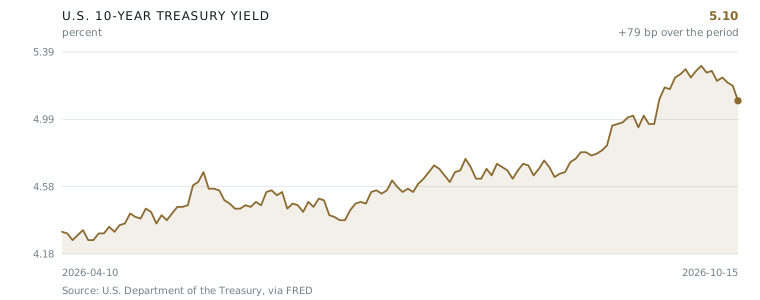
- 01The U.S. 10-year Treasury yield was 5.10% on 15 October.
- 02The U.S. 2-year yield was 4.77%, the effective federal funds rate was 3.88%, and SOFR was 3.89%.
- 03Chinese investors are reported to be moving into dividend stocks to shelter from market turmoil.
- 04Guotou Securities was cited as saying gold is showing an obvious bottom signal.
- 05One bearish call said Bitcoin is unlikely to break above US$100,000 before year-end.
Interpretation, not reporting. The facts above carry their tiers; this is one correspondent’s reading of them.
The market is not pricing a hike; it is pricing a long, expensive tail. I would treat the dividend-and-gold preference as a defensive response to that curve, not as a clean verdict on growth. A 10-year at 5.10% against an effective federal funds rate of 3.88% makes carry look like protection, while a 2-year at 4.77% keeps short money from feeling cheap. In that setting, the Bitcoin cap is plausible only if the marginal buyer remains rate-sensitive and wary of the Iran conflict. The weakest part of the story is the leap from market commentary to allocation fact: the double-return argument for dividend stocks over state bonds has no period or index, and the gold bottom call is still a call. I would need to see the long end fall, or the war premium fade, before treating the ceiling as temporary. If the 10-year stays near 5.10% through the year, I would expect income and hedges to keep their advantage over high-volatility upside.
— Odile Marchetti
Every claim in this article, and what it rests on
We do not ask you to take our word for it. Each statement below carries its tier and its sources. Where sources disagree, you get both accounts and what would settle it.
The U.S. 10-year Treasury yield was 5.10% on 2026-10-15.
The U.S. 2-year Treasury yield was 4.77% on 2026-10-15.
The effective federal funds rate was 3.88% and SOFR was 3.89% on 2026-10-15.
Chinese investors are moving into dividend stocks to shelter from market turmoil.
Dividend stocks have delivered returns double those of state bonds.
Guotou Securities said gold is showing an obvious bottom signal.
Bitcoin is unlikely to break above US$100,000 before the end of the year as rising interest rates and the Iran conflict continue.
Bitcoin faces a real risk of further sharp pullbacks.
The case against this story
Written by an adversarial reviewer, not the correspondent
The story's internal logic is muddled. It reports an effective federal funds rate of 3.88%—well below the 5.25–5.50% range of 2023–2024—indicating the Federal Reserve has been cutting rates. Yet it then attributes Bitcoin's ceiling to 'rising interest rates,' which is only coherent if referring to long-term yields or market expectations of future hikes, not the policy rate itself. The story never makes this distinction, leaving readers to assume rates are currently rising. The 2-year yield at 4.77% sitting 89 basis points above the 3.88% fed funds rate is unusual in an easing cycle and suggests the market expects rates to reverse higher—but the story does not explain this. The 10-year at 5.10% with fed funds at 3.88% creates a 122 basis point spread, a steep curve that typically signals growth expectations, which sits awkwardly alongside the 'market turmoil' framing. The claim that dividend stock returns are 'double' those of state bonds is a precise quantitative assertion with no specified time period, index, or methodology. The attribution of a gold 'bottom signal' to 'Guotou Securities' needs verification of both the firm name and the specific research note. The reference to an 'Iran conflict' as a driver of Bitcoin weakness is an unverified geopolitical assertion used to support a price prediction.
Who benefits from this framing: Bearish Bitcoin traders and short sellers benefit from the narrative that Bitcoin is unlikely to break $100,000, as it could deter buying and encourage selling. Holders of Chinese dividend stocks benefit from the 'shelter from turmoil' framing, which could attract inflows into their positions. Gold bulls benefit from the 'obvious bottom signal' call, which could drive buying. The overall 'market turmoil' framing benefits sellers of safe-haven and hedging products, and benefits those who have already positioned defensively by validating their allocations.
Report an error in this article
Subscriptions open at launch
Global Wealth Review will be a paid publication. Reading is free while we build the archive — leave an address and we will write to you once, when subscriptions open.