
AI debt warnings meet a 5.10% Treasury and a calm VIX
Multilateral language on AI and debt stress now has to be tested against a bond market pricing a steep curve and an unusually calm equity volatility gauge.
 Odile MarchettiCentral banks, rates and sovereign debt

The IMF and World Bank closed their annual meeting with warnings that placed artificial intelligence alongside debt stress. U.S. rates on 15 October showed a 5.10% 10-year Treasury yield, a 4.77% two-year yield and an effective federal funds rate of 3.88%. The CBOE VIX closed at 16.46, leaving investors to decide whether the official language is a risk signal or merely conference vocabulary.
On 15 October, the U.S. 10-year Treasury yield stood at 5.10%. The two-year yield was 4.77%, and the effective federal funds rate was 3.88%. Those three numbers describe a curve that is no longer inverted: the ten-year paid 33 basis points more than the two-year, and both sat well above the overnight policy rate.
The same session produced a less obvious signal. The CBOE VIX closed at 16.46. A long bond above 5% normally raises the discount rate applied to future earnings and can pressure equity valuations, yet the equity volatility gauge was not flashing. The market’s message is not that debt warnings are wrong; it is that equity volatility has not yet been drafted to enforce them.
A steep curve with a quiet volatility gauge
The arithmetic is simple. Higher long-term yields raise the cost of refinancing public debt and increase the duration risk held by investors. A two-year at 4.77% shows that the market is not pricing an immediate collapse in policy rates, while an effective federal funds rate of 3.88% shows where short-term money currently sits. The gap between the two points to term and inflation risk being paid at the long end.
The VIX complicates that picture. It measures expected equity volatility through options, not the credit stress that can build in bond markets. A reading of 16.46 alongside a 5.10% ten-year does not prove confidence. It may instead show that equity investors are not yet forced to hedge a rate shock that bond investors already own.
The market’s message is not that debt warnings are wrong; it is that equity volatility has not yet been drafted to enforce them.
AI enters the debt-stress vocabulary
That is where the IMF and World Bank language lands. The institutions concluded their annual meeting, and the closing was described as marked by warnings about artificial intelligence and about debt. Verité Research was also described as active on the global debt agenda at the meetings, though that phrase does not say whether the role was substantive or ceremonial.
The link between AI and sovereign credit runs through budgets and guarantees. If public money supports compute, power, data infrastructure or industrial adaptation, the spending can show up as debt, contingent liabilities or pressure on credit metrics. If AI raises productivity and tax revenues, it can ease the same burden. The warning is therefore not a forecast; it is a request that investors add another variable to the duration and credit screen.
The market tape from 15 October does not settle that argument. A 5.10% ten-year is a funding fact. A 16.46 VIX is a positioning fact. They can coexist if equity markets see higher yields as an economic normal rather than a solvency trigger. They can also coexist briefly, before a repricing in one market spills into the other.
The test is whether the calm lasts
The strongest reading is narrow. Official institutions have put AI financing pressures into the same conversation as sovereign debt risk, while U.S. rates already show an expensive long end and a calm equity volatility gauge. The weaker part is causality: nothing in the same-day numbers proves that the warnings changed prices, or that the yield level validates the warnings.
The next signal would be convergence. If the ten-year remains near 5.10% and the VIX moves higher, the calm becomes harder to explain. If yields fall while volatility stays low, the debt-stress language may look like conference seasoning. If the curve steepens with volatility, the screen changes from vocabulary to risk management.
The open question is whether 16.46 is the sound of a market that has absorbed 5.10%, or the silence before a different kind of repricing.
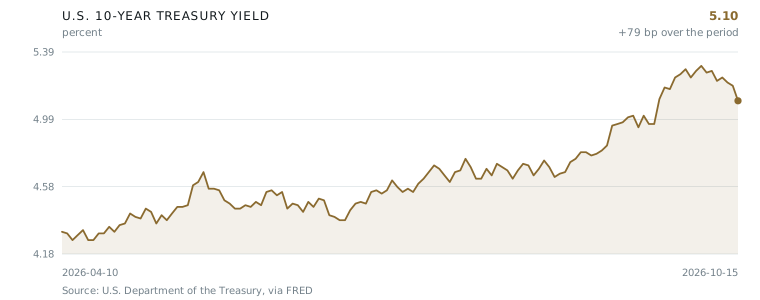
- 01The U.S. 10-year Treasury yield was 5.10% on 15 October.
- 02The U.S. two-year Treasury yield was 4.77% on the same day.
- 03The effective federal funds rate was 3.88% on 15 October.
- 04The CBOE VIX closed at 16.46 on 15 October.
- 05The IMF and World Bank concluded their annual meeting, with the closing described as marked by warnings on AI and debt.
Interpretation, not reporting. The facts above carry their tiers; this is one correspondent’s reading of them.
The interesting fact is not the warning but the divergence. On 15 October, the 10-year Treasury yield was 5.10%, the two-year was 4.77%, the effective federal funds rate was 3.88%, and the VIX closed at 16.46. I read that combination as a market accepting higher long-term funding costs without immediate equity turbulence. That does not prove the IMF and World Bank were wrong to link artificial intelligence and debt at their annual meeting; it means the language has not yet changed positioning enough to appear in volatility. Verité Research being active on the global debt agenda does not settle whether that role was substantive. If the 10-year stays near 5.10% while the VIX remains subdued, I would treat the warnings as a slow credit screen rather than an alarm. If the curve steepens and volatility rises with it, the story becomes more urgent. What would change my mind is evidence that the calm VIX is not confidence but fragility, or that the meeting language starts moving prices. Until then, I see two separate signals: high long money, low equity fear.
— Odile Marchetti
Every claim in this article, and what it rests on
We do not ask you to take our word for it. Each statement below carries its tier and its sources. Where sources disagree, you get both accounts and what would settle it.
The U.S. 10-year Treasury yield was 5.10% on 15 October 2026.
The U.S. 2-year Treasury yield was 4.77% on 15 October 2026.
The effective federal funds rate was 3.88% on 15 October 2026.
The CBOE VIX close was 16.46 on 15 October 2026.
The IMF and the World Bank concluded their annual meeting.
The closing of the IMF-World Bank annual meeting was marked by warnings about artificial intelligence.
The closing of the IMF-World Bank annual meeting was marked by warnings about debt.
Verité Research was active on the global debt agenda at the IMF-World Bank Annual Meetings.
The case against this story
Written by an adversarial reviewer, not the correspondent
The story pairs two sets of claims that do not clearly connect: IMF-World Bank meeting summaries and specific U.S. market data. The meeting claims lean on interpretive language—'marked by warnings'—that could overstate how prominent AI and debt actually were in the closing; someone at the same session might describe the emphasis differently. The Verité Research claim uses 'active on the global debt agenda,' a phrase elastic enough to cover anything from a side-event seat to a keynote, leaving the reader unable to judge whether the organisation's role was substantive or ceremonial. On the market-data side, the combination of a 5.10% 10-year Treasury yield with a VIX of only 16.46 is historically discordant: the last time the 10-year approached 5%, equity volatility was markedly higher. Either one figure is off, or the low VIX reflects a market complacency that directly undercuts the debt-warning narrative the story is building. The story implies a coherent picture—global debt risk, market signals confirming it—but the pieces may not fit together as neatly as presented, and the reader is given no primary sources to check.
Who benefits from this framing: Verité Research benefits from being portrayed as an active player on the global debt agenda at premier international financial meetings, a characterisation that enhances its institutional credibility and influence regardless of how substantive its actual role was. If the 5.10% Treasury yield is meant to underscore the IMF-World Bank debt warnings, advocates of fiscal austerity and critics of government borrowing benefit from a framing that implies markets are already pricing in fiscal crisis. AI-safety and regulation advocates benefit from AI being elevated to a headline-level warning at the highest levels of international finance. Finally, anyone selling debt-restructuring advisory services, sovereign-risk insurance, or crisis-preparedness products benefits from an amplified sense of debt danger.
Report an error in this article
Subscriptions open at launch
Global Wealth Review will be a paid publication. Reading is free while we build the archive — leave an address and we will write to you once, when subscriptions open.