
Argentina's arrears spike and bond weakness signal credit squeeze
Domestic balance-sheet stress is showing up in sovereign pricing, but the numbers behind the alarm are thin.
 Odile MarchettiCentral banks, rates and sovereign debt

Argentina's country risk is reported above 640 points, while local outlets say about 59,000 to 60,000 companies have debt-payment problems. The U.S. 10-year Treasury yield stood at 5.21% on 13 October, raising the external funding hurdle. The missing link is who holds the debt and whether the arrears are spreading.
On 13 October, the U.S. 10-year Treasury yield stood at 5.21%. That is the global price of safe duration. For a borrower already carrying local stress, it sets the bar that any new financing must clear.
In Argentina, that bar is being tested alongside a jump in country risk. Market coverage puts the risk premium above 640 points and describes it as rising again. The same coverage says sovereign bonds suffered a widespread collapse and that Argentine stocks declined.
Those are three different markets speaking at once. The alarm is about the linkage, not any single number. If companies cannot pay, banks and suppliers tighten terms; if the sovereign’s bonds weaken, the currency and refinancing options come under pressure; if equities fall, the cost of capital rises.
The spread is the price of doubt
Country risk is a spread, not a balance-sheet line. When it rises, investors demand more compensation to hold the sovereign’s debt relative to benchmark Treasuries. A move above 640 points matters less because of the level than because of what it does to refinancing: it pushes new borrowing costs higher and makes short extensions more likely.
The alarm is about the linkage, not any single number.
Argentina’s spreads have been volatile before, and the available data does not say whether 640 is an outlier or a familiar stress level. That absence matters. A number that would be extreme for many sovereigns can be routine for Argentina during periods of stress. The reader needs the range, not just the spot.
The available descriptions overlap. A risk premium above 640 points and a premium rising again are two ways of describing the same move. The phrase “widespread collapse” in sovereign bonds is more dramatic than the available market data, which does not include percentage declines or the specific securities affected.
Sixty thousand companies is a count without a definition
The corporate figure is the most concrete-sounding part of the story and the least defined. Diario Popular and Diario Jornada both report that between about 59,000 and 60,000 companies in Argentina have problems paying their debts. That corroboration gives the number weight, but the available reports do not explain what counts as a payment problem.
A company that misses a coupon, one that renegotiates a bank loan, and one that delays a supplier invoice are not the same credit event. Without that distinction, the count cannot say whether the stress is concentrated in small illiquid firms or spread across employers, exporters and large borrowers. The difference matters because losses travel through different creditors.
If the arrears are mostly small service companies with peso liabilities, the transmission to bondholders is indirect. If they include larger exporters or firms with market access, the pressure on refinancing becomes more direct. Those are different trades, even if the headline count sounds the same.
The U.S. yield is a hurdle, not a verdict
The 5.21% U.S. 10-year yield does not, by itself, explain Argentina’s stress. It raises the external cost of capital for many borrowers, but the available data does not show a direct transmission from that rate to the Argentine arrears count. A high benchmark can coexist with local stress that is driven by domestic cash flows, regulation or confidence.
What would make the story stronger is a chain of counterparties. Which lenders hold the corporate debt? Are the arrears showing up in bank loan performance, supplier credit, or bond covenants? Are the bond declines concentrated in dollar obligations or local-currency paper? Those answers would turn a collection of weak signals into a credit thesis.
A stock decline can reflect global risk appetite as much as domestic distress, and bond weakness can come from liquidity as much as solvency. For now, the market has a price move, a broad count and a set of reported declines. The missing piece is the holder of the debt. Until that is known, the squeeze may be real but still not investable as a single trade.
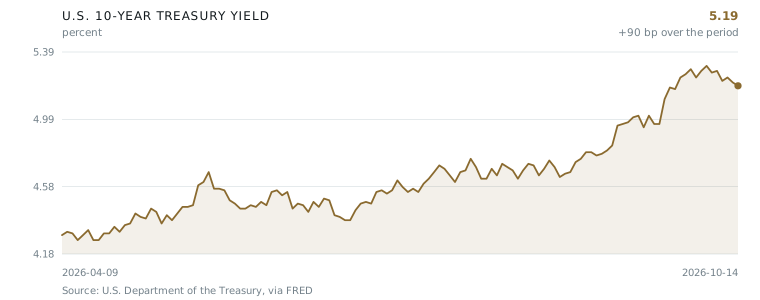
- 01The U.S. 10-year Treasury yield was 5.21% on 13 October.
- 02Diario Popular and Diario Jornada report about 59,000 to 60,000 Argentine companies have debt-payment problems.
- 03Market coverage puts Argentina’s country risk above 640 points and describes sovereign bonds as weak.
- 04Argentine stocks are reported to have declined.
Interpretation, not reporting. The facts above carry their tiers; this is one correspondent’s reading of them.
The market is being asked to treat three different frictions as one crisis: a spread above 640 points, a loosely defined count of corporate arrears, and a high U.S. benchmark yield. I would not go that far on the evidence. The spread matters because it prices the sovereign’s funding access; the corporate count matters only if it identifies which creditors will absorb losses. At present, the count has no disclosed methodology, and the bond moves lack percentages. The U.S. yield is a global hurdle, not proof of an Argentina-specific transmission. If later reporting defines what counts as a debt-payment problem and shows the 59,000 to 60,000 figure is rising through consecutive months, the squeeze becomes harder to dismiss. If the same country-risk level appears without a broader move in stocks or bonds, I would treat it as volatility. The question is not whether stress exists, but whether the data can separate a liquidity wobble from a solvency problem.
— Odile Marchetti
Every claim in this article, and what it rests on
We do not ask you to take our word for it. Each statement below carries its tier and its sources. Where sources disagree, you get both accounts and what would settle it.
The U.S. 10-year Treasury yield was 5.21% on 2026-10-13.
Between about 59,000 and 60,000 companies in Argentina have problems paying their debts.
Argentina's country risk rose above 640 points.
Argentina's sovereign bonds experienced a widespread collapse.
Argentina's country risk was rising again.
Argentine stocks declined.
The case against this story
Written by an adversarial reviewer, not the correspondent
The story stacks overlapping negative signals to amplify alarm: country risk above 640 points AND 'rising again' are two claims about the same indicator, not independent data points. 'Widespread collapse' of sovereign bonds is editorial language that may exceed actual price movements. The precise-sounding count of 59,000–60,000 companies with 'problems paying their debts' pairs false numerical precision with an undefined criterion, inflating the appearance of quantitative rigor. The inclusion of the U.S. 10-year Treasury yield at 5.21% implies a causal narrative—high American interest rates crushing Argentina—without any evidence of linkage between the two. Normal market volatility, transient risk-premium shifts, and routine corporate delinquencies could produce every data point here without indicating a structural emergency. The story provides no historical context for whether 640 points is exceptional for Argentina, no percentage figures for the bond or stock declines, and no methodology behind the company count.
Who benefits from this framing: Short sellers of Argentine sovereign bonds and equities profit directly from falling prices amplified by crisis narratives. Holders of Argentine debt can leverage crisis framing to demand higher yields or harsher restructuring terms. Domestic political opponents of Argentina's current government benefit from economic pessimism. International creditors and financial institutions can justify stricter lending conditions or intervention requirements. Media outlets gain engagement from dramatic crisis headlines. Speculators in currency markets benefit if the peso sells off on fear.
Report an error in this article
Subscriptions open at launch
Global Wealth Review will be a paid publication. Reading is free while we build the archive — leave an address and we will write to you once, when subscriptions open.