
Asia's dollar channel faces a fine story and a 5.24% yield
A Bank of America enforcement account and central-bank talks arrive while high Treasury yields and a firm dollar raise the cost of cross-border dollar funding.
 Odile MarchettiCentral banks, rates and sovereign debt

The 10-year US Treasury yield was 5.24% on 9 October, the two-year was 4.80%, and the broad dollar index was 121.6023. Analysts have assessed that a historic US Treasury fine on Bank of America tied to Chinese money-laundering networks would affect US-China capital streams, while a separate account says the PBOC, BOJ and BOK held their fifteenth tripartite governors' meeting. The VIX closed at 15.21 on 12 October.
The 10-year US Treasury yield closed at 5.24% on 9 October, while the two-year yield stood at 4.80%. The broad dollar index was 121.6023 on the same day. Those are not Asian numbers, but they set the price at which Asia must borrow, hedge and hold dollars.
The gap of 44 basis points between the two- and 10-year yields says the long end is carrying a term premium, not simply policy expectations. A firm dollar and an expensive 10-year bond raise the hurdle for any Asian bank, exporter or fund that needs dollar funding for more than a few days. The holder of a 10-year Treasury at 5.24% is being paid to wait; the Asian borrower who must roll dollars is paying for time. The VIX closed at 15.21 on 12 October, so equity markets are not flashing the same warning as rates.
The fine would work through correspondent banking
Analysts have assessed that the US Treasury imposed historic fines on Bank of America over compliance failures tied to Chinese money-laundering networks, and that the penalty would have implications for US-China capital streams. In that account, the bank is not the point; the clearing channel is. A large clearing bank under enforcement pressure can change how smaller institutions access the currency.
The fine itself is not a market price; the compliance response is.
If such an enforcement move were documented and acted on, the mechanism would run through correspondent banking. US dollar payments clear through US banks, and compliance departments respond to penalties by tightening screening, demanding more beneficial-owner information and narrowing relationships. For Chinese-linked flows, that can mean slower settlement, more rejected transactions and higher costs for trade finance and cross-border investment. The effect would not arrive as a single shock. It would appear as extra questions on know-your-customer files, longer payment queues and a quieter retreat from relationships that are hard to explain to a regulator.
The fine itself is not a market price; the compliance response is. The caution is that the enforcement narrative is being carried by analysts rather than by a named Treasury statement, so the market effect depends on whether banks change behavior before any official record appears. That distinction matters for portfolio construction. A documented penalty can reprice clearing relationships quickly; an unverified story can only widen risk premiums where compliance officers are already cautious.
Central banks are talking, but the dollar is doing the work
A separate account says the People's Bank of China, the Bank of Japan and the Bank of Korea held the Fifteenth Tripartite Governors' Meeting. The significance is not the title; it is the possibility that the region's official sector is comparing notes while dollar funding is expensive.
Central-bank coordination does not automatically create liquidity. It can, however, reduce the chance of a disorderly response if payment frictions and high yields begin to bite at the same time. The meeting is a signal of attention, not a backstop. The market's test is whether official communication stays ceremonial or becomes operational through swaps, standing arrangements or clearer guidance for banks caught between US compliance pressure and Asian trade flows.
Where the pressure lands
The first point of contact is the payments desk, not the trading screen. A bank that must re-check Chinese-linked dollar transactions will price that work into fees, credit lines and the willingness to hold inventory. That is a slow form of tightening, and it does not require a crisis. It can show up first in less favorable financing terms for smaller traders, then in wider spreads for cross-border deals, and finally in the kind of liquidity gap that becomes visible only when someone needs dollars quickly.
The open question is whether the Bank of America story becomes a documented enforcement action and whether the PBOC-BOJ-BOK meeting produces anything beyond consultation. Until then, the hard numbers are the 5.24% 10-year yield, the 4.80% two-year and the 121.6023 dollar index. The VIX at 15.21 says investors are not paying for panic. The rates market says the dollar is not cheap.
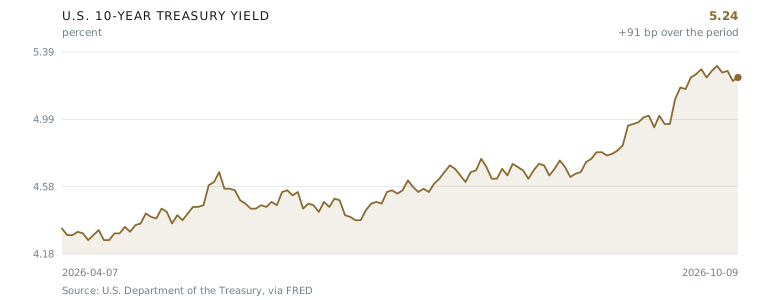
- 01The 10-year US Treasury yield was 5.24% on 9 October.
- 02The two-year US Treasury yield was 4.80% on 9 October.
- 03The broad dollar index was 121.6023 on 9 October.
- 04The VIX closed at 15.21 on 12 October.
- 05Analysts have assessed that a Bank of America fine tied to Chinese money-laundering networks would affect US-China capital streams.
Interpretation, not reporting. The facts above carry their tiers; this is one correspondent’s reading of them.
The credible pressure here is not the fine; it is the funding curve. I would separate the two. The Bank of America account is sourced to analysts, not to a visible Treasury settlement, so it belongs in the watch file rather than the risk model. The 10-year yield at 5.24%, the two-year at 4.80% and the dollar index at 121.6023 are hard prices, and they already raise the cost of any dollar-dependent Asia position. The PBOC-BOJ-BOK meeting could matter if it turns into standing communication about liquidity, but the market data show no emergency: the VIX at 15.21 is not a stress print. My test is simple. If a documented Treasury action appears and correspondent banks start narrowing Chinese-linked dollar clearing, the story becomes operational. If not, the real constraint remains the high long-end yield.
— Odile Marchetti
Every claim in this article, and what it rests on
We do not ask you to take our word for it. Each statement below carries its tier and its sources. Where sources disagree, you get both accounts and what would settle it.
The CBOE VIX closing value was 15.21 on 12 October 2026.
The broad dollar index DTWEXBGS was 121.6023 on 9 October 2026.
The 2-year US Treasury yield was 4.80% on 9 October 2026.
The 10-year US Treasury yield was 5.24% on 9 October 2026.
The US Treasury imposed historic fines on Bank of America.
The Bank of America fines were tied to compliance failures involving Chinese money-laundering networks.
Analysts assessed the Bank of America fine as having implications for US-China capital streams.
The PBOC, BOJ, and BOK held the Fifteenth Tripartite Governors' Meeting.
The case against this story
Written by an adversarial reviewer, not the correspondent
The strongest case against this story is that every single assertion — from historic Treasury fines on Bank of America tied to Chinese money-laundering networks, to analyst assessments of US-China capital streams, to a PBOC-BOJ-BOK governors' meeting, to four specific market data points — is presented without a single named source, document, dataset, or official statement. There is no Treasury enforcement announcement, no central-bank press release, no CBOE settlement file, no Fed H.10 or H.15 release. The narrative is internally coherent — a major US bank punished over Chinese networks, Asian central banks coordinating separately, elevated Treasury yields, a strong dollar — but that coherence is constructed entirely from unsupported claims. A reader cannot distinguish this story from fabrication, and the combination of a sensational enforcement narrative with precise-but-uncited market data is a classic structure for disinformation: the hard numbers lend false credibility to the softer claims. The tier-A market data points in particular should be trivially sourced yet are not, which is more alarming than if they were merely difficult to verify.
Who benefits from this framing: If a reader believes this framing, it benefits parties who profit from a narrative of escalating US-China financial confrontation. Short-sellers or options traders positioned against Bank of America equity or credit benefit from the fine narrative. China hawks and advocates of stricter US capital controls or sanctions benefit from a major US bank being linked to Chinese money-laundering networks. Any actor seeking to amplify alarm about rising Treasury yields and dollar strength benefits from the uncited market data, which could drive defensive trading or policy pressure. More broadly, a foreign information operator seeking to erode confidence in US financial institutions and the independence of US-China capital flows would find this exact framing useful — it pairs punitive enforcement against an American bank with Asian central-bank coordination that appears to exclude the US, suggesting American isolation and vulnerability.
Report an error in this article
Subscriptions open at launch
Global Wealth Review will be a paid publication. Reading is free while we build the archive — leave an address and we will write to you once, when subscriptions open.