
Big tech earnings test AI management as bond yields stay high
A calm equity volatility gauge and a high 10-year yield make this earnings week a test of whether AI agents become productive assets or operational overhead.
 Noor HaddadDigital assets, custody and settlement

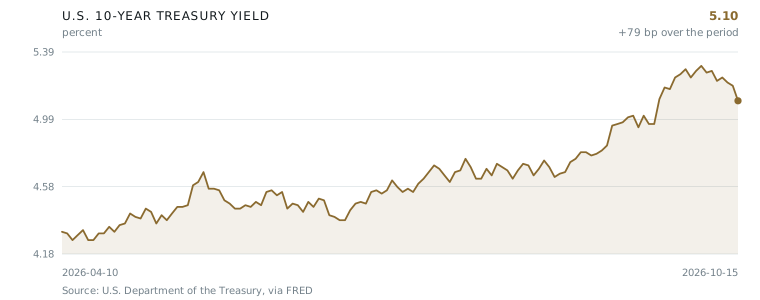
The VIX closed at 16.46 on 15 October, while the 10-year US Treasury yield stood at 5.10%. A week-ahead schedule lists Meta, Tesla, Texas Instruments and Western Digital earnings, a SpaceX entry that is not comparable to a listed report, and Nvidia's GTC Berlin. The question is whether AI agents appear as measurable productivity or as another layer of management cost.
On 15 October, the VIX closed at 16.46 and the 10-year US Treasury yield stood at 5.10%. One gauge says equity traders are not paying much for protection. The other says bond investors are demanding a high price for duration. That gap is the backdrop for a week in which AI management risk meets company disclosures.
A crowded calendar, with one odd entry
According to the week-ahead schedule, Meta, Tesla, Texas Instruments and Western Digital are set to report in the week following 18 October. Nvidia's GTC Berlin conference is also on the calendar. The same schedule lists SpaceX, but that entry does not sit in the same category as a listed-company earnings date.
The mechanism is simple. Earnings turn AI from a conference theme into numbers: capital expenditure, depreciation, software costs, headcount, revenue attribution and margin impact. A conference can show a roadmap. A report can show whether the roadmap is being paid for by productivity or by a larger operating bill.
Meta and Tesla matter because they carry large AI and automation narratives into their own cost bases. Texas Instruments and Western Digital sit closer to the physical supply chain, where demand, inventories and pricing can be less forgiving. Nvidia's Berlin event may set expectations for the next layer of compute, but it will not settle the accounting question.
The robot, in other words, may need a manager, and the manager may need a ticketing system.
Autonomy now comes with supervision
The promise around AI agents has been framed as autonomous digital workers. The more sceptical version circulating in the industry is that the reality is human management of digital workers. If that account is right, the agent is not a replacement for labour; it is a new operational unit that requires approvals, exception handling, audit trails and rollback.
That changes the economics. A worker replaced by software removes a cost line. A managed digital worker adds software, monitoring, integration, compliance and the humans who intervene when the output is wrong. The key question is not whether the model can generate an answer. It is who holds the approval key, what happens when the agent fails, and which ledger absorbs the cost.
The robot, in other words, may need a manager, and the manager may need a ticketing system. For investors, that turns AI from a story about capability into a story about operating leverage. Capability can be demonstrated. Operating leverage has to clear in the accounts.
Calm equity, expensive funding
The market picture is not internally neat. A VIX at 16.46 suggests the equity options market is not bracing for large moves. A 10-year yield at 5.10% raises the hurdle for every long-duration promise, including AI projects whose returns are expected years ahead.
Those two signals can coexist for a while. Equity volatility can stay low while funding costs remain high, especially if investors expect earnings to carry the burden of proof. But the combination leaves little room for disappointment. If disclosures show AI spending improving margins, the calm may look earned. If they show agents adding supervision costs without measurable throughput, the bond market's higher yield becomes a harder benchmark.
None of this requires a sudden repricing. It only requires the market to keep asking what the AI spend is buying. If the answer is faster throughput with fewer handoffs, the asset case holds. If the answer is more monitoring, more controls and more escalation, the liability case gains weight.
The week's test is therefore not whether AI is big. It is whether the money is settling into productive assets or into a new layer of operational overhead. Watch the cost lines, the capitalisation choices and the language around agent productivity. The open question is whether any of these companies can show an agent clearing work end-to-end without a human queue forming behind it.
- 01The VIX closed at 16.46 on 15 October.
- 02The 10-year US Treasury yield was 5.10% on 15 October.
- 03A week-ahead schedule lists Meta, Tesla, Texas Instruments and Western Digital earnings after 18 October.
- 04The same schedule lists Nvidia's GTC Berlin conference and a SpaceX entry.
- 05An industry account says AI agents require human management rather than full autonomy.
Interpretation, not reporting. The facts above carry their tiers; this is one correspondent’s reading of them.
This week only matters if the disclosures turn AI management from a promise into a cost line. I would treat the low VIX and the high 10-year yield as two different clocks: one says equity traders are relaxed, the other says capital is expensive and patience is shorter. The earnings calendar is the place where those clocks meet. If Meta, Tesla, Texas Instruments or Western Digital can show agents reducing friction without adding supervisors, approvals and exception handling, the calm may be justified. If the language is full of oversight, controls and human sign-off, then the agent story starts to look like software with a payroll attached. Nvidia's Berlin event can move expectations, but it cannot settle the ledger. The SpaceX entry on the same schedule is a reminder that event noise can masquerade as market signal. My test is narrow: does the week produce a mechanism where work clears, costs are allocated, and the key holder is identifiable? If not, the market may be calm only because it has not yet priced the management overhead.
— Noor Haddad
Every claim in this article, and what it rests on
We do not ask you to take our word for it. Each statement below carries its tier and its sources. Where sources disagree, you get both accounts and what would settle it.
The VIX closed at 16.46 on 15 October 2026.
The 10-year US Treasury yield was 5.10% on 15 October 2026.
Meta is scheduled to disclose earnings in the week following 18 October 2026.
Tesla is scheduled to disclose earnings in the week following 18 October 2026.
SpaceX is scheduled to disclose earnings in the week following 18 October 2026.
Texas Instruments and Western Digital are scheduled to disclose earnings in the week following 18 October 2026.
Nvidia's GTC Berlin conference is scheduled to be held.
The promise of AI agents as autonomous digital workers has been followed by a reality in which humans manage digital workers.
The case against this story
Written by an adversarial reviewer, not the correspondent
The story's overall picture is undermined by the inclusion of SpaceX alongside public companies for scheduled earnings—SpaceX is a private company with no public earnings calendar, which suggests the earnings-week narrative was assembled to maximize drama rather than reflect verifiable events. Additionally, the story pairs a low VIX close of 16.46 (signaling market calm) with a 5.10% 10-year Treasury yield (a level historically associated with significant economic stress), creating an internally inconsistent market picture that goes unexplained. The claim that AI agents have failed to deliver autonomy and instead require human management is an opinion presented alongside factual market and scheduling claims, which lends it an unwarranted aura of established fact. Taken together, the story appears constructed to frame a consequential, high-stakes week rather than to report independently verified events.
Who benefits from this framing: Readers who accept this framing benefit those constructing a high-drama earnings-week narrative that could drive trading activity around the named stocks. The inclusion of SpaceX—despite it being private—could benefit those trading secondary-market SpaceX shares or derivatives by creating false expectations of imminent public disclosures. The claim that humans must manage digital workers benefits consulting firms and vendors selling human-in-the-loop AI management tools by framing their services as necessary rather than optional. The high Treasury yield figure, if believed, benefits those positioning for higher rates or selling fixed-income products, while the low VIX figure benefits those promoting calm-market strategies or selling volatility.
Report an error in this article
Subscriptions open at launch
Global Wealth Review will be a paid publication. Reading is free while we build the archive — leave an address and we will write to you once, when subscriptions open.