
BOJ liquidity notes meet a stubborn U.S. long end
Two quiet Bank of Japan publications arrive while U.S. long yields stay high and short funding is lower.
 Odile MarchettiCentral banks, rates and sovereign debt

The U.S. 10-year Treasury yield stood at 5.21% on 13 October, while EFFR and SOFR were 3.88% and 3.89%. The Bank of Japan’s website listed an October market-operations summary and a Koeda speech on 15 October. The combination puts the focus on liquidity plumbing rather than a sudden policy shift.
On 13 October, the U.S. 10-year Treasury yield closed at 5.21%, only three basis points below the 5.24% level of 9 October. That is not a move. It is a posture. The short end, by contrast, sat much lower: the effective federal funds rate was 3.88% and SOFR was 3.89% on the same day, while the two-year Treasury yield was 4.79%, down one basis point from 4.80% on 9 October.
The gap between these numbers is the story. A central bank that has pushed overnight money near 3.9% would normally be expected to pull long-dated financing down with it if the market believed the easing was sufficient. Instead, the ten-year coupon remains 42 basis points above the two-year yield. The gap is wide enough to show that holders of long paper are demanding extra compensation for duration, supply, or fiscal risk. The exact mix is not settled. The price signal is.
The curve is doing the worrying
Equity volatility is not confirming stress. The VIX closed at 15.27 on 13 October, a level that usually belongs to a market expecting orderly conditions. The broad dollar index DTWEXBGS stood at 121.6023 on 9 October. A firm dollar can tighten conditions for borrowers outside the United States, and for a Japanese holder of dollar assets it changes the yen value of income and principal before hedging is considered.
A market-operations summary is not a policy statement; it is the plumbing ledger.

The mechanism runs through funding. When EFFR and SOFR are near 3.9%, cash is no longer scarce in the way it was when short rates were higher. But long Treasury investors are not buying cash; they are buying a promise to be paid years from now. If they require 5.21% to hold that promise, the Treasury can still fund itself, but the cost of rolling debt stays high. For a sovereign that issues constantly, a few basis points at the long end become billions over time.
Tokyo’s paperwork arrives quietly
The Bank of Japan added two communications on 15 October. The central bank says it published a summary of the Meeting on Market Operations for October 2026, and it also says Board Member Koeda delivered a speech in Kumamoto titled “Economic Activity, Prices, and Monetary Policy in Japan.” Both were listed on the Bank of Japan’s website on 15 October.
The titles are broad, and the immediate fact is the timing: Tokyo is giving the market official texts while the U.S. curve remains steep and equity volatility stays low. Some will treat the releases as routine; others will read them for a shift in liquidity management. A market-operations summary is not a policy statement; it is the plumbing ledger. It can show whether the BOJ is letting balances run down, adjusting purchases, or smoothing money-market functioning while policy normalizes. A board-member speech can frame the same question in economic terms: how much tightening can activity and prices bear?
For Japanese rates, the interaction is direct. If the BOJ keeps liquidity ample while the U.S. long end stays high, the gap between domestic funding and foreign yields remains wide. If it leans toward restraint, the yen and domestic bond supply become more important. The titles do not specify the operational stance, so the safe reading is narrower: two official texts have arrived at the same time as a steep U.S. curve and a calm VIX.
What would change the picture
The next test is whether the 10-year yield starts to follow the short end lower. A sustained move below 5% would suggest long investors are accepting the easing path. A hold above 5.2% while EFFR and SOFR stay near 3.9% would keep the fiscal-duration pressure in place.
The second test is operational. If the BOJ’s October summary shows smaller purchases or more frequent use of short-term funds operations, that would point to normalization through the balance sheet rather than through rhetoric. If Koeda’s language emphasizes price risks over activity risks, it would reinforce the same direction. The market has the numbers to watch; it does not yet have the BOJ’s arithmetic.
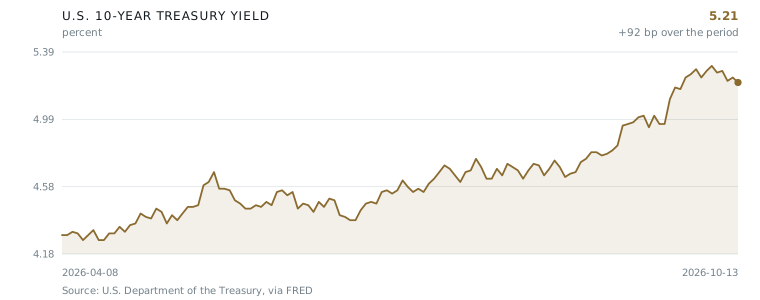
- 01The U.S. 10-year yield was 5.21% on 13 October, down from 5.24% on 9 October.
- 02The two-year yield was 4.79%, after 4.80% on 9 October.
- 03EFFR was 3.88% and SOFR was 3.89% on 13 October.
- 04The VIX closed at 15.27 and the dollar index was 121.6023.
- 05The Bank of Japan’s website listed an October market-operations summary and a Koeda speech on 15 October.
Interpretation, not reporting. The facts above carry their tiers; this is one correspondent’s reading of them.
The steep U.S. curve is doing more work than the calm VIX. I would treat the Bank of Japan’s two publications as plumbing signals rather than policy hints until the operations summary shows actual sizes. The market is comfortable enough to keep equity volatility at 15.27, yet long Treasury investors still demand 5.21% while overnight funding sits near 3.9%. That combination suggests duration, not panic, is being priced. For Japanese allocators, the issue is whether the BOJ lets normalization run through markets without forcing a repricing of foreign positions. If the 10-year yield breaks below 5% while EFFR and SOFR stay near current levels, I would conclude the long end is accepting the easing path. If it stays above 5.2% and the BOJ’s language emphasizes prices over activity, the pressure on fiscal credibility remains the dominant force. I would change my mind if the operations summary showed materially larger purchases or a clear return to abundant reserves, because that would mean Tokyo is choosing to suppress term premiums rather than merely manage them.
— Odile Marchetti
Every claim in this article, and what it rests on
We do not ask you to take our word for it. Each statement below carries its tier and its sources. Where sources disagree, you get both accounts and what would settle it.
The VIX closed at 15.27 on 13 October 2026.
The U.S. 2-year Treasury yield was 4.79% on 13 October 2026, after being 4.80% on 9 October 2026.
The U.S. 10-year Treasury yield was 5.21% on 13 October 2026, after being 5.24% on 9 October 2026.
The broad dollar index DTWEXBGS was 121.6023 on 9 October 2026.
U.S. short-term funding rates were 3.88% for EFFR and 3.89% for SOFR on 13 October 2026.
The Bank of Japan published a summary of the Meeting on Market Operations for October 2026.
Bank of Japan Board Member Koeda delivered a speech in Kumamoto titled “Economic Activity, Prices, and Monetary Policy in Japan.”
The Koeda speech and the October 2026 market-operations summary were available on the Bank of Japan’s website on 15 October 2026.
The case against this story
Written by an adversarial reviewer, not the correspondent
The story presents a tightly coherent set of financial data points and central-bank communications for mid-October 2026, but no underlying evidence—no links, screenshots, data feeds, or documents—is actually supplied. The internal consistency across the claims (Fed easing to 3.88% EFFR, 10-year yields at 5.21%, calm VIX at 15.27, BOJ speeches and market-operations summaries) could just as easily reflect careful construction as genuine reporting. The specific combination creates a narrative: the Fed has eased significantly, yet long-term yields remain elevated, suggesting fiscal-sustainability concerns, while equity markets stay calm and the BOJ provides parallel communications. This narrative conveniently supports specific investment theses. The 10-year yield at 5.21% is the linchpin—if that figure is wrong, the entire 'high long-term yields despite Fed easing' story collapses. The BOJ claims add international texture but rest on a generic speech title that could apply to almost any BOJ board member appearance. Without primary sources—a Fed H.15 release, NY Fed rate data, CBOE VIX settlement, or direct BOJ website links—the whole picture is an assertion, not an evidenced report.
Who benefits from this framing: If a reader believes this framing, the beneficiary is whoever is positioning investments or arguments around the specific narrative it constructs: Fed easing (EFFR at 3.88%) combined with elevated long-term yields (10-year at 5.21%) and calm equity markets (VIX at 15.27). This combination supports trades that bet on steepening yield curves, fiscal-sustainability concerns, or equity complacency. The inclusion of BOJ communications adds a cross-border dimension that could support yen-carry or Japan-related positioning. A reader who accepts these specific numbers as fact could be steered toward duration, curve-steepening, or currency trades that benefit the presenter. Additionally, anyone arguing that central banks are losing control of long-term rates despite easing would find this data set conveniently supportive.
Report an error in this article
Subscriptions open at launch
Global Wealth Review will be a paid publication. Reading is free while we build the archive — leave an address and we will write to you once, when subscriptions open.