
China’s GDP beat and gold call meet a 5.10% yield hurdle
A calm VIX and a high long bond are forcing investors to decide whether China’s latest signals are growth trades or policy hedges.
 Odile MarchettiCentral banks, rates and sovereign debt

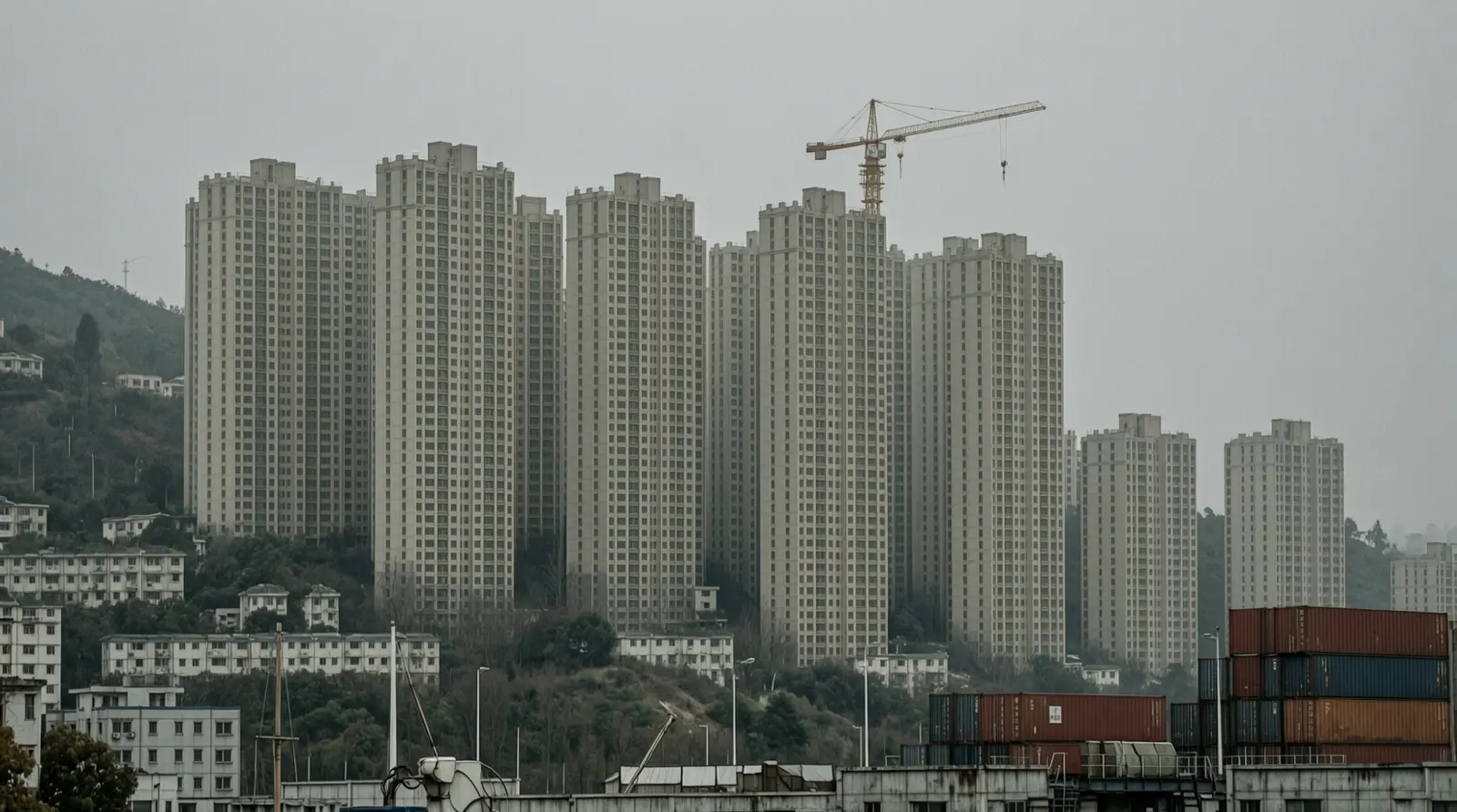
China’s reported third-quarter growth of 4.5% and a brokerage call that gold has bottomed are reviving the policy-hedge trade. The US 10-year Treasury yield at 5.10% raises the cost of carrying any hedge that depends on financing or cross-border capital. The question is whether Hong Kong property, gold and mainland demand are responding to growth or to control risk.
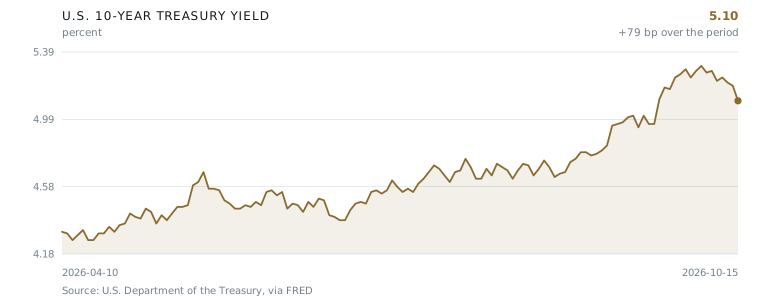
The VIX closed at 16.46 on 15 October. The US 10-year Treasury yield stood at 5.10% on the same day. One number says equity markets are calm. The other says long-dated dollar money is expensive. That gap is the right place to examine a set of China stories that otherwise look like simple optimism.
A beat that still needs a trade map
China’s third-quarter expansion was reported at 4.5%, beating forecasts and picking up from the second quarter. The same set of reports tied the pickup to an AI-driven boom in exports. A growth print, however, cannot by itself identify the products that led the trade. It shows the total, not the composition.
For an allocator, that distinction matters. If the acceleration came from a narrow set of technology-linked goods, the recovery is vulnerable to export controls, foreign demand or a single supply chain. If it came from a broader basket, the signal is different. The figures cited do not settle that question.
The 5.10% US 10-year yield also changes the read. A stronger Chinese print can support risk assets, but expensive long-dated Treasuries keep global financial conditions tight. They raise the cost of financing trades and the hurdle for emerging-market exposure. The VIX may be quiet while the bond market is doing the disciplining.
The VIX may be quiet while the bond market is doing the disciplining.
Hong Kong property is doing double duty
The other leg of the story is property. Beijing imposed a 20% tax on rental income and capital gains derived from overseas properties, according to the reports. Mainland Chinese buyers were still described as driving Hong Kong’s housing market despite that levy.
If the tax is new, the same period’s transactions cannot prove that demand has shrugged it off. They can only show that buying continued while the rule was being digested. The more interesting mechanism is why mainland buyers go to Hong Kong in the first place. A flat there is not just shelter. It is a claim outside the mainland’s capital-control perimeter, with different legal and currency arrangements.
That makes the tax ambiguous. It can be read as a revenue measure. It can also be read as a signal that the perimeter around capital may tighten. In that second reading, demand for Hong Kong assets is not a pure growth trade. It is a hedge against a future restriction.
The 20% number gives the policy a hard edge. A buyer who expects capital gains must now assume that a fifth of the gain, and of rental income, can be claimed by Beijing. If enforcement is credible, the after-tax return on overseas property falls sharply. If enforcement is uncertain, the tax may instead accelerate moves into assets that are harder to monitor or that sit in jurisdictions with clearer ownership records.
Gold’s bottom call meets an expensive bond
The final piece is gold. Guotou Securities said gold bottom signals are obvious. That is a call from one brokerage, not a confirmed turn. It also arrives against a difficult backdrop: gold pays no coupon, so a 5.10% 10-year Treasury yield is a direct opportunity cost.
A gold bottom is easier to argue when rates are falling or when fear is rising. Here, the VIX at 16.46 does not show panic. The case must therefore rest on insurance rather than momentum: protection against capital-control surprises, geopolitical shocks or a sudden change in the rules that govern cross-border wealth.
The buyers who matter are not the tourists of a normal metal rally. They would be institutions and family offices trying to hold an asset with no counterparty, outside the banking system’s direct ledger. If those buyers appear while yields remain high, the bottom call gains force. If they wait for lower rates, gold is simply another rate-sensitive trade.
The open question is whether these flows are chasing growth or preparing for friction. The GDP number, the Hong Kong purchases and the gold call can all be true without adding up to a broad recovery. They may instead be three expressions of the same impulse: capital looking for a place where a policy surprise cannot reach it.
- 01The VIX closed at 16.46 on 15 October.
- 02The US 10-year Treasury yield was 5.10% on 15 October.
- 03China’s third-quarter growth was reported at 4.5%, beating forecasts.
- 04Reports said Beijing imposed a 20% tax on overseas property income and gains.
- 05Guotou Securities said gold bottom signals are obvious.
Interpretation, not reporting. The facts above carry their tiers; this is one correspondent’s reading of them.
The cleanest way to read this bundle is to separate growth from insurance. I can accept that China’s reported 4.5% third-quarter growth beat forecasts, but I cannot accept that it proves an AI export boom without trade composition. The Hong Kong property flow looks less like confidence in prices and more like demand for a legal perimeter, especially with a 20% tax on overseas property income and gains. Gold is harder: Guotou Securities can call a bottom, but a 5.10% US 10-year yield is a real hurdle for a non-yielding asset. What would change my mind is persistence. If mainland buying in Hong Kong continues after the tax is enforced, and if gold finds buyers while the 10-year stays near 5.10% and the VIX remains near 16.46, the hedge argument becomes stronger. If those flows fade once financing costs bite, the story collapses back into an ordinary cyclical beat.
— Odile Marchetti
Every claim in this article, and what it rests on
We do not ask you to take our word for it. Each statement below carries its tier and its sources. Where sources disagree, you get both accounts and what would settle it.
The VIX closing level was 16.46 on 2026-10-15.
The US 10-year Treasury yield was 5.10% on 2026-10-15.
China's economy grew 4.5% in the third quarter, beating forecasts.
China's third-quarter GDP growth picked up from the second quarter.
An AI-driven boom in exports accompanied China's third-quarter GDP pickup.
Beijing imposed a 20% tax on rental income and capital gains derived from overseas properties.
Mainland Chinese buyers continue to drive Hong Kong's housing market despite Beijing's 20% tax.
Guotou Securities said gold bottom signals are obvious.
The case against this story
Written by an adversarial reviewer, not the correspondent
The story paints a picture of a robust Chinese economic recovery: GDP beating forecasts, AI exports booming, and mainland demand for Hong Kong property undeterred by a new tax. But the strongest counter-argument is that the causal claims outrun the evidence. The 'AI-driven boom in exports' is asserted without any trade-composition data showing AI products drove export growth—GDP figures alone cannot establish this link. The 20% overseas property tax is stated as a precise fact without any cited official government document. And the claim that mainland buyers 'continue to drive' Hong Kong housing despite this tax is logically impossible to support if the tax was only just imposed—there has not been enough time to observe its effect on buyer behavior. Meanwhile, the US 10-year Treasury yield at 5.10% signals significant global financial stress and tight financial conditions, which historically pressure emerging-market capital flows including China's. A 4.5% GDP growth rate, even if it 'beat forecasts,' remains modest by China's own historical standards and does not by itself indicate a broad-based recovery. The gold 'bottom signal' comes from a single securities firm and is a speculative market call, not a confirmed trend. Taken together, the story's optimistic framing leans on under-sourced causal claims and a premature policy-impact assessment while ignoring the broader signal of stress from elevated US yields.
Who benefits from this framing: If a reader believes this framing, several parties benefit. The Chinese government and its economic policymakers benefit from a 'growth beating forecasts' narrative that reinforces confidence in their management of the economy. AI and technology sector companies and their investors benefit from the 'AI-driven exports' characterization, which could boost sector valuations and justify further capital allocation. Hong Kong property developers, agents, and current homeowners benefit from the claim that mainland Chinese demand remains strong despite the new tax, as this supports property prices and transaction volumes. Gold investors and mining companies benefit from the 'gold bottom signals are obvious' call, which could drive buying interest and lift prices. And holders of Chinese equities broadly benefit from the overall recovery narrative, which supports asset prices across the board.
Report an error in this article
Read everything for 14 days, free
All three titles in full, the full daily brief, and an alert when a claim about something you follow changes. No card, and it ends by itself.