
Citi’s capital-scarcity warning meets a steep curve
If sovereigns and companies bid for the same limited funds, term premia and credit spreads can reprice together.
 Odile MarchettiCentral banks, rates and sovereign debt

The 10-year Treasury yielded 5.21% on 13 October, while the effective federal funds rate and SOFR were both 3.88% on 14 October. Citi said governments and businesses are competing for limited funds, describing the stance as hawkish. The gap between long and short rates puts the burden of proof on the supply side of the market.
On 13 October, the 10-year Treasury yielded 5.21%. The next day, the effective federal funds rate and SOFR both stood at 3.88%.
That is a 133-basis-point gap between long money and overnight money. The two-year yield, at 4.79%, adds a second detail: the curve is not inverted. It is steep enough to make the price of duration, not the scarcity of reserves, the immediate question.
Citi said governments and businesses are competing for funds. It described its stance as hawkish and said the competition for limited funds is intensifying. That is a warning about crowding: sovereign issuance and corporate borrowing drawing on the same pool of savings.

A steep curve is not the usual tight-money shape
A genuinely tight policy stance usually shows up in short-dated yields that remain high relative to longer maturities, because investors expect the central bank’s pressure to slow growth and inflation. The current shape points the other way. The 10-year sits 42 basis points above the two-year and 133 basis points above the overnight policy anchor.
A steep curve can be a warning about supply, not a vote for tighter policy.
That pattern is more consistent with investors demanding compensation for holding longer-dated debt than with markets expecting the central bank to keep policy restrictive forever. A steep curve can be a warning about supply, not a vote for tighter policy.
The distinction matters for portfolios. If the long end is rising because policy is expected to stay high, shorter maturities carry less duration risk. If it is rising because investors need more pay to absorb debt, the pressure can spread to any borrower priced off sovereign yields.
The channel runs from Treasury auctions to corporate treasurers
Citi’s argument becomes concrete only when the mechanism is named. Governments borrow at the long end through bonds that set the benchmark for everything else. A ministry selling 10-year paper and a corporate treasurer issuing a five-year bond are not in separate rooms. They are both asking investors to commit capital for years, and the second borrower must pay a spread over the first.
When long yields rise, the corporate funding cost rises even if credit spreads stay unchanged. A company refinancing a bond due in 2026 faces a different bill than one that locked rates years ago. Banks can tighten the transmission by demanding more yield for balance-sheet risk, and asset managers can demand more because the risk-free alternative has become richer.
This is where the word “limited” does work. Capital is always scarce in some sense, but a scarcity episode becomes visible when borrowers must bid against one another for the same duration. The evidence so far is in the levels: overnight funding at 3.88%, while 10-year money costs 5.21%.
The buyer decides whether this is a squeeze
The missing piece is who holds the debt. An insurer or pension fund may look at 5.21% and see a liability-matching opportunity. A foreign official holder may weigh reserves, currency and liquidity. A leveraged fund may demand even more premium for volatility. The auction calendar and the credit market can both provide tests, but the buyer is the common factor.
If the marginal buyer is a real-money institution willing to absorb supply, the funding squeeze may remain a term-premium story. If the marginal buyer steps back, both sovereigns and companies may need to pay more to clear markets. The next signal will come from whether corporate spreads begin to move with the long Treasury, rather than merely after it. That would be the point at which a sovereign story becomes a credit story.
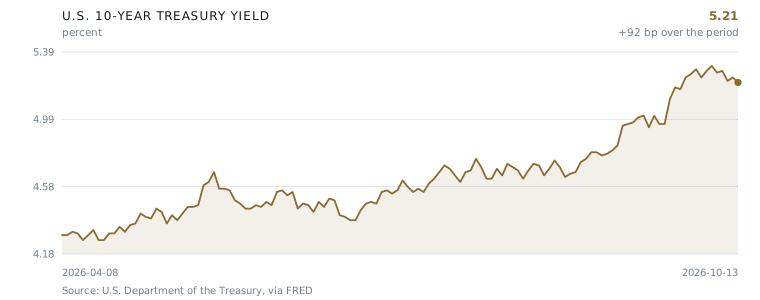
- 01The 10-year Treasury yielded 5.21% on 13 October.
- 02The two-year Treasury yielded 4.79% on the same day.
- 03The effective federal funds rate and SOFR were both 3.88% on 14 October.
- 04Citi said governments and businesses are competing for funds.
- 05Citi described its stance as hawkish and the competition as intensifying.
Interpretation, not reporting. The facts above carry their tiers; this is one correspondent’s reading of them.
Citi’s warning is most useful as a fiscal signal, not a monetary one. The 5.21% 10-year against an overnight rate of 3.88% tells me investors are being asked to hold more duration, not that policy is about to tighten further. If the bank is right that governments and companies are bidding for the same limited funds, the pressure should show up first in term premia and then in credit. I would watch whether the 10-year stays high while the two-year remains near 4.79%, and whether corporate spreads start to widen alongside rather than after Treasury moves. The comparison breaks down if the long end falls while short rates stay anchored; that would suggest growth or inflation expectations are doing less work than supply. I would also change my mind if SOFR moved decisively above 3.88%, because that would bring money-market tightness into the story. Until then, the curve is describing a debt-absorption problem. The squeeze is possible, but it is not yet a policy squeeze.
— Odile Marchetti
Every claim in this article, and what it rests on
We do not ask you to take our word for it. Each statement below carries its tier and its sources. Where sources disagree, you get both accounts and what would settle it.
The U.S. 10-year Treasury yield was 5.21% on 2026-10-13.
The U.S. 2-year Treasury yield was 4.79% on 2026-10-13.
The effective federal funds rate was 3.88% on 2026-10-14.
SOFR was 3.88% on 2026-10-14.
Citi said governments and businesses are competing for funds.
Citi has adopted a hawkish stance.
Citi said the competition for funds is intensifying.
Citi said the funds being competed for are limited.
The case against this story
Written by an adversarial reviewer, not the correspondent
The story's 'hawkish' label is contradicted by its own data. The 10-year Treasury at 5.21% while the effective federal funds rate sits at 3.88% produces a 133-basis-point gap — a steepening curve that typically signals growth expectations or fiscal-supply concerns, not monetary tightness. A genuinely hawkish environment would compress that gap, not widen it. The claim that governments and businesses are 'competing for limited funds' describes a structural, perennial feature of capital markets, not a new intensifying dynamic. High long-end yields more plausibly reflect term premium and heavy Treasury issuance than a central bank leaning hawkish. The story conflates fiscal concerns (too much government debt supply) with monetary hawkishness (tight central bank policy), which are analytically distinct.
Who benefits from this framing: Fiscal conservatives and austerity advocates benefit from the 'governments competing with businesses for limited funds' framing, which bolsters arguments for cutting public spending and deficits. Bond bears and short-sellers benefit from a hawkish narrative that could push yields further. Asset managers positioned for higher-for-longer rates benefit from normalising the idea of persistently elevated long-term yields, locking in gains from that trade.
Report an error in this article
Subscriptions open at launch
Global Wealth Review will be a paid publication. Reading is free while we build the archive — leave an address and we will write to you once, when subscriptions open.