
Digital money rules tighten while AI wealth pitches wait for proof
Central bank work on stablecoins and tokenisation is setting the perimeter, but it does not validate any private AI adviser.
 Odile MarchettiCentral banks, rates and sovereign debt

Central bank work on stablecoins, tokenisation and AI risk is defining the regulatory perimeter for digital money. Market rates show the funding backdrop, while a private AI wealth platform is drawing attention with a billion-dollar valuation target. The two tracks are converging in narrative, not in legal endorsement.
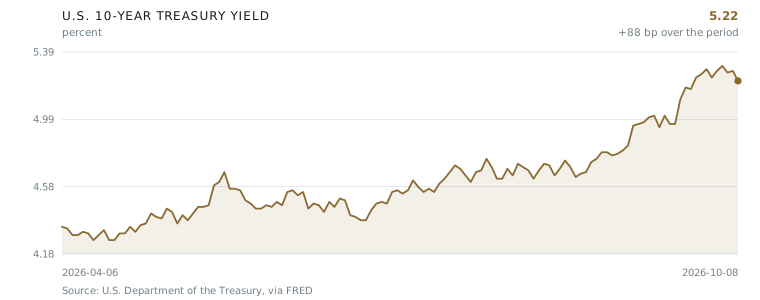
On 8 October 2026, the 10-year US Treasury yield stood at 5.22%, and SOFR printed 3.87%. Those two rates sit at the centre of the digital-money question because they determine what a stablecoin issuer can earn on reserve assets, and how much it must pay to keep dollars credible.
The Federal Reserve Board has now requested public comment on two proposals related to establishing a regulatory framework for Board-supervised payment stablecoin issuers under the GENIUS Act. That is a concrete step toward defining who may issue dollar-linked tokens, what assets back them, and which supervisors can demand changes when redemption pressure arrives.
Stablecoins are becoming a balance-sheet business
The mechanism is direct. A payment stablecoin is a promise to exchange one digital dollar for one real dollar. If the issuer holds Treasury bills or overnight funds, higher short-term rates can turn that promise into a profitable float. But the same rates also raise the opportunity cost for holders and increase the pressure on the issuer to prove that reserves are liquid, valued correctly and available in stress.

The Fed’s proposals matter because they move that question from marketing language into supervisory language. Comment periods will shape capital, liquidity, disclosure and enforcement expectations for issuers that want a federal perimeter. Investors should watch whether the final rules treat stablecoins as narrow payment utilities, as bank-like deposit substitutes, or as something in between.
The useful way to read this convergence is to separate plumbing from product.
The European Central Bank is working on adjacent ground. The ECB published a speech by Piero Cipollone titled “Money in the digital age: digital euro, tokenisation and the role of central banks”. It also published remarks by Isabel Schnabel and Christine Lagarde that touch on blockchain settlement and AI risk.
The ECB’s work on a digital euro, tokenisation and AI risk sets rules for public money, market infrastructure and supervisory oversight. It does not amount to approval of any private wealth-management product that uses AI agents to select investments.
AI wealth management is a different risk stack
The private side of the story is moving faster than the public side. By one account, a former top HSBC executive has launched an AI-driven wealth-management platform powered by a team of AI agents. The same account says the founder has set her sights on a billion-dollar valuation.
Those are venture ambitions, not regulatory milestones. An AI wealth platform does not become safer because central banks are studying tokenisation, nor does a stablecoin framework make an automated portfolio manager more trustworthy. The risks sit in different places. Stablecoin regulation concerns payment promises, reserve assets and redemption. AI wealth management concerns suitability, model failure, data governance, conflicts, liability and the old problem of who pays when an automated decision loses money.
The valuation ambition is also a financing story, not a performance record. A billion-dollar target may help recruit talent and raise capital, but it tells an allocator nothing about drawdowns, client retention, model governance or the cost of human oversight.
The perimeter is being drawn around plumbing
The useful way to read this convergence is to separate plumbing from product. Central banks and the Fed are working on the plumbing: settlement rails, reserve assets, digital money and the treatment of new operational risks. Private AI platforms are building products that sit on top of that plumbing.
For investors, the near-term regulatory perimeter is likely to appear first around issuers, custodians and market infrastructure. That is where supervisors can measure reserves, audit code, demand capital and intervene before a run. Wealth advice is harder to supervise because the damage often appears client by client, through unsuitable allocations or opaque model decisions, rather than through a single balance sheet that can be examined on a Friday afternoon.
The open question is whether the two tracks will merge under one supervisory logic, or remain separate regimes that only collide during a failure. The next test will be whether stablecoin rules demand enough transparency to let investors see who holds the debt, and whether AI advisers disclose enough to let clients see who is on the other side of the trade.
- 01The Fed sought public comment on two proposals for Board-supervised payment stablecoin issuers under the GENIUS Act.
- 02SOFR was 3.87% on 8 October 2026, while the 10-year US Treasury yield was 5.22%.
- 03The ECB published a Cipollone speech on the digital euro, tokenisation and central banks.
- 04ECB remarks by Schnabel and Lagarde are listed under short titles whose exact status is disputed.
- 05By one account, a former top HSBC executive launched an AI wealth platform, and the founder targeted a billion-dollar valuation.
Interpretation, not reporting. The facts above carry their tiers; this is one correspondent’s reading of them.
The regulatory work is real; the implied endorsement is not. I would keep the Fed’s stablecoin proposals, the ECB’s digital-euro and tokenisation speeches, and the AI-risk remarks in one bucket: public plumbing. The private AI wealth platform belongs in another: a financing and product story. A billion-dollar valuation target may signal ambition, but it does not show that the agents can manage risk. The 10-year Treasury at 5.22% and SOFR at 3.87% matter because they price the reserves and funding that underpin digital-money businesses, not because they validate any automated adviser. I would change my view only if a supervisor explicitly tied its stablecoin or AI framework to performance, suitability and liability standards for such platforms. Until then, the interesting question is not whether these tracks converge, but which track gets enforcement first.
— Odile Marchetti
Every claim in this article, and what it rests on
We do not ask you to take our word for it. Each statement below carries its tier and its sources. Where sources disagree, you get both accounts and what would settle it.
The Federal Reserve Board requested public comment on two proposals related to establishing a regulatory framework for Board-supervised payment stablecoin issuers under the GENIUS Act.
The ECB published a speech by Piero Cipollone titled 'Money in the digital age: digital euro, tokenisation and the role of central banks'.
SOFR was 3.87% on 8 October 2026.
The 10-year US Treasury yield was 5.22% on 8 October 2026.
The ECB published a speech by Isabel Schnabel titled 'Central banks on-chain'.
The ECB published a speech by Christine Lagarde titled 'Where AI risks meet'.
A former top HSBC executive launched an AI-driven wealth-management platform powered by a team of AI agents.
The founder of the AI-driven wealth-management start-up set her sights on a billion-dollar valuation.
The case against this story
Written by an adversarial reviewer, not the correspondent
The story's central weakness is structural, not per-claim. It packages legitimate regulatory and market developments (Fed stablecoin proposals, ECB speeches, SOFR/Treasury data) alongside promotional content for a private AI wealth-management start-up (Claims 7 and 8). This juxtaposition creates a halo effect: the start-up appears institutionally validated by proximity to Fed and ECB actions, even though those actions concern stablecoin regulation, digital euro policy, and AI risk — none of which specifically endorse or relate to an AI-driven wealth-management platform. The 'billion-dollar valuation' claim (Claim 8) is aspirational ('set her sights on'), not achieved, yet sits alongside hard market data and verifiable regulatory actions, lending it a false equivalence. A reader could easily infer that the regulatory items create tailwinds for this specific start-up, when the causal connection is absent.
Who benefits from this framing: The AI wealth-management start-up and its founder benefit most. Placement of their launch and valuation ambitions alongside tier-A regulatory and market news lends unwarranted institutional credibility. Potential investors, partners, or clients reading this framing would subconsciously associate the start-up with Fed/ECB developments, inflating perceived legitimacy, lowering perceived risk, and potentially supporting a higher valuation or easier fundraising than the standalone merits of Claims 7 and 8 would justify.
Report an error in this article
Subscriptions open at launch
Global Wealth Review will be a paid publication. Reading is free while we build the archive — leave an address and we will write to you once, when subscriptions open.