
ECB’s AI optimism meets a 5.24% bond test
Growth from artificial intelligence may need to outrun borrowing costs that are already squeezing sovereign budgets.
 Odile MarchettiCentral banks, rates and sovereign debt

Philip Lane’s ECB essay frames AI as Europe’s productivity opening, but a 5.24% 10-year US Treasury yield and an IMF warning on borrowing costs put fiscal strain in the same frame. Singapore’s 5.4% third-quarter growth shows momentum in the global cycle, while OpenAI’s reported device discovery and an arrest account add a governance question that is not yet documented. The investment problem is whether AI can improve output and debt capacity before high rates turn fiscal pressure into market stress.
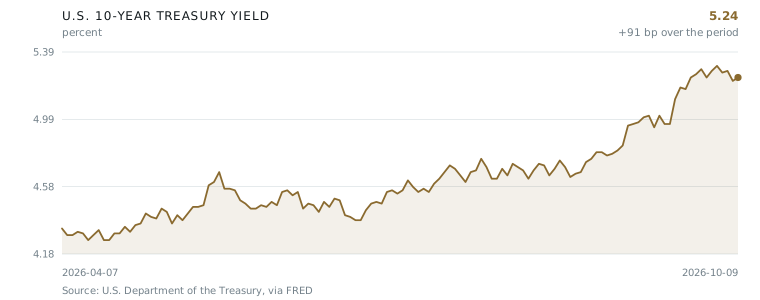
On 9 October, the US 10-year Treasury yield stood at 5.24 percent, and the 2-year was at 4.80 percent. Those are not abstract levels: they set the price at which governments roll debt, companies refinance, and households compare a safe bond against a risky growth story. Into that pricing environment, the European Central Bank has placed a counterargument: Philip R. Lane’s “The AI opportunity for Europe,” published by ECB press, treats artificial intelligence as a productivity opening rather than only a bubble or a threat.
The mechanism is simple. If AI lifts output per worker, future tax receipts and corporate earnings can grow faster than the debt burden compounding on existing bonds. If it does not, high yields become a heavier constraint, because governments must refinance with larger interest bills while investors demand more compensation for holding long-dated paper. The IMF has warned that higher borrowing costs are straining public finances worldwide, which is the fiscal version of the same arithmetic.
Growth must arrive before debt service bites
Singapore’s advance government estimate gives a sense of the growth side. The economy expanded 5.4 percent in the July-September quarter, a strong result for a trade-dependent economy that often turns before the broader cycle. That number does not prove AI is driving the gain, but it shows that the global expansion still has pockets of momentum even as rates stay elevated. For Europe, Lane’s argument is that AI adoption could widen those pockets rather than leave them confined to a few nimble economies.
The productive case and the security case do not carry the same weight.
The bond market is less forgiving. A 10-year yield above 5 percent means long-duration sovereign debt is already pricing a world in which inflation risk, supply needs, or term premium demand extra compensation. The 2-year at 4.80 percent suggests the market does not expect policy rates to fall quickly enough to erase that pressure. If AI is to matter to portfolios, it must show up in productivity data, capital spending, and earnings before the refinancing calendar turns fiscal strain into a market event.
Security stories need evidence before they move capital
The technology side brings a different kind of risk, but with weaker verification. OpenAI said it discovered a hidden recording device wrapped in toilet paper behind a television in one of its offices. A separate account says an engineer for OpenAI was arrested for planting a listening bug. Those details are dramatic, but they are not yet the kind of record that a court filing, charging document, or regulator would normally provide. Until they are confirmed, they remain an open question rather than a settled national-security thesis.
Why does that matter to markets? Governance failures, espionage, or sabotage can hit technology companies through litigation, security spending, employee trust, and regulatory scrutiny. But the size of the effect depends on whether the incident is isolated or systemic, and on whether the facts survive scrutiny. If the device story holds, it raises operational-security concerns for firms handling valuable models and data. If it does not, the episode becomes a warning about how quickly a sensational detail can be stitched into an investment narrative.
The asymmetry is the point
The productive case and the security case do not carry the same weight. Lane’s essay is an official institutional argument about Europe’s potential. The US yield figures are market facts. Singapore’s GDP is an official advance estimate. The OpenAI incident and arrest account are still at the level of assertion. That asymmetry matters: an investor can model a 5.24 percent 10-year yield and an IMF warning about public finances; modeling a bug wrapped in toilet paper is harder, because the probability of the story being accurate is itself uncertain.
The open question is whether AI can become visible in the numbers that matter to sovereign credit: productivity, tax revenue, and the capacity to service debt. If European adoption accelerates and shows up in output per hour within a few quarters, Lane’s optimism gains a hard edge. If yields stay elevated while growth remains patchy, the fiscal warning becomes the dominant signal. And if the OpenAI security account is confirmed by official documents, it would add a new governance premium to the technology sector; if not, it becomes noise rather than a governance premium.
- 01ECB press published Philip R. Lane’s “The AI opportunity for Europe.”
- 02US 10-year and 2-year Treasury yields were 5.24 and 4.80 percent on 9 October.
- 03The IMF warned higher borrowing costs are straining public finances worldwide.
- 04Singapore’s GDP expanded 5.4 percent in the July-September quarter, according to advance government estimates.
- 05OpenAI said it found a hidden recording device; the related arrest account remains unconfirmed.
Interpretation, not reporting. The facts above carry their tiers; this is one correspondent’s reading of them.
The useful story here is not AI versus security; it is productivity versus the refinancing calendar. I can see a path in which Lane’s optimism becomes investable only if adoption shows up in European output per hour quickly enough to ease the arithmetic behind a 5.24 percent 10-year yield and an IMF warning about public finances. Singapore’s 5.4 percent advance estimate is encouraging, but it does not prove that Europe can translate AI into fiscal capacity. The OpenAI device and arrest account is the weaker leg. If a court filing or regulator confirms it, I would treat operational security as a real cost and governance risk for model developers. If not, I would treat the espionage framing as noise and keep the focus on rates. What would change my mind: verified documentation of the arrest, or European productivity data that moves within a few quarters. Until then, the stronger signal is debt service, not drama.
— Odile Marchetti
Every claim in this article, and what it rests on
We do not ask you to take our word for it. Each statement below carries its tier and its sources. Where sources disagree, you get both accounts and what would settle it.
ECB press published an item featuring Philip R. Lane titled 'The AI opportunity for Europe'.
The U.S. 10-year Treasury yield was 5.24 percent on 9 October 2026.
The U.S. 2-year Treasury yield was 4.80 percent on 9 October 2026.
Singapore's GDP expanded 5.4 percent in the July-September quarter, according to advance government estimates.
OpenAI said it discovered a hidden recording device wrapped in toilet paper behind a television in one of its offices.
A Saudi-born engineer for OpenAI was arrested for planting a listening bug.
The IMF warned that higher borrowing costs are straining public finances worldwide.
The case against this story
Written by an adversarial reviewer, not the correspondent
The story's overall picture leans on two unverified, sensational espionage claims — a hidden recording device wrapped in toilet paper at an OpenAI office and the arrest of a Saudi-born engineer — both sitting at the lowest confidence tier, yet presented alongside high-confidence market data and official institutional publications. This juxtaposition creates a halo effect: the espionage claims borrow credibility from the verifiable economic figures surrounding them. The detail that the arrested individual is 'Saudi-born' introduces a nationality framing that, if unsubstantiated by a charging document or court filing, is potentially defamatory and prejudicial. If the device discovery and arrest claims are exaggerated, unconfirmed, or based on a single anonymous source, the entire narrative about AI as a national-security battleground collapses, leaving only routine economic data and a standard ECB opinion piece. The story also pairs a 10-year yield at 5.24 percent with an IMF warning about borrowing costs, implying a coherent fiscal-stress narrative, but if either the yield figure or the IMF characterization is slightly off, that coherence is manufactured rather than real.
Who benefits from this framing: Readers who accept this framing become more receptive to several agendas simultaneously. National-security hawks benefit from AI being cast as an espionage battlefield, particularly with the 'Saudi-born' detail that primes suspicion toward foreign nationals at U.S. tech firms. Fiscal-austerity advocates benefit from the pairing of elevated Treasury yields with an IMF borrowing-cost warning, which together argue for spending cuts. Those shorting government bonds or pushing for higher interest rates benefit from the 5.24 percent figure, which reinforces a narrative of fiscal stress. And anyone seeking to slow or restrict OpenAI's operations benefits from security-breach framing that questions the company's internal safeguards.
Report an error in this article
Subscriptions open at launch
Global Wealth Review will be a paid publication. Reading is free while we build the archive — leave an address and we will write to you once, when subscriptions open.