
Europe's rally meets Draghi's inflation warning
A small decline in U.S. Treasury yields helped European stocks absorb tech weakness, but Draghi's inflation-first remarks and U.S. debt warning leave the easing story unsettled.
 Odile MarchettiCentral banks, rates and sovereign debt

The U.S. 10-year Treasury yield declined from 5.21% on 13 October to 5.19% on 14 October, a small move that coincided with reports of higher European equity markets on 15 October. Falling yields were reported to have offset a technology-sector selloff, but Mario Draghi said the same day that inflation is the priority for the European Central Bank and that U.S. debt poses a risk. An 8 October report said bond-spread anxiety was not attributable to Italy, though that reassurance came a week before the session.
The U.S. 10-year Treasury yield declined from 5.21% on 13 October to 5.19% on 14 October. Two basis points is not a trend. It is enough, however, to alter the marginal pressure on equities when the weakness is concentrated in one sector rather than coming from rates themselves.
European equity markets were reported to have finished higher on 15 October, and falling bond yields were reported to have offset a technology-sector selloff. The channel is familiar. Lower long-dated yields reduce the discount rate applied to future earnings, which matters most for stocks whose prices rest on cash flows further out. In a single session, that can turn a tech-led decline into a rotation rather than a broad retreat.
The support, though, is narrow. A move from 5.21% to 5.19% does not show that financing conditions have become easy. It shows only that, across those two days, the bond market stopped adding weight to an equity problem. It is a pause, not a pivot.

That creates a temptation to read too much into a small change. A two-basis-point decline can still matter at the margin, because equity indexes do not need a large fall in rates to stabilise when selling pressure is sector-specific. But the same smallness means the next session can reverse the effect without any new macro news.
Two basis points is not a trend.
Draghi's words land in a sensitive place
Mario Draghi said on 15 October that inflation is the priority for the European Central Bank. He also said that debt in the United States poses a risk. Those two points pull against the simple version of the rally.
If inflation remains the priority, the path to easier policy is less automatic than equity investors might hope. If U.S. debt is a risk, then the global benchmark yield can stay volatile, and European assets cannot simply import calm from Treasury markets. The remarks do not prove that policy will tighten or that U.S. debt will destabilise anything. They do complicate the assumption that lower yields are a stable backdrop. That also raises the cost of assuming that the bond market has already done its work.
The distinction between speech and policy is not academic. Markets often price tone before they can verify the institution behind it. Draghi's words are clear; the ECB's next move is not. That gap is where narratives outrun evidence.
The Italy question is not settled by one line
An 8 October report said anxiety over bond spreads was not attributable to Italy. That is useful context, but it comes from a week before the 15 October equity session. In sovereign debt, a week can be enough for a new concern to attach itself to a familiar name.
The practical test is in the spread itself. If peripheral debt widens while core stays steady, the market is repricing credit or political risk. If Italy's spread does not lead, the stress may sit elsewhere. The report does not identify the alternative source, so the clean answer is that the earlier report reduces one fear without removing the need to watch the tape.
That leaves the rally with a precise but fragile foundation. Equities rose because yields fell enough to absorb tech weakness. Draghi's inflation-first warning and U.S. debt caution make that foundation look less like a floor and more like a pause. The next session will show whether that bid was real or merely mechanical. The open question is whether European stocks can hold when the bond market asks for more than two basis points of help.
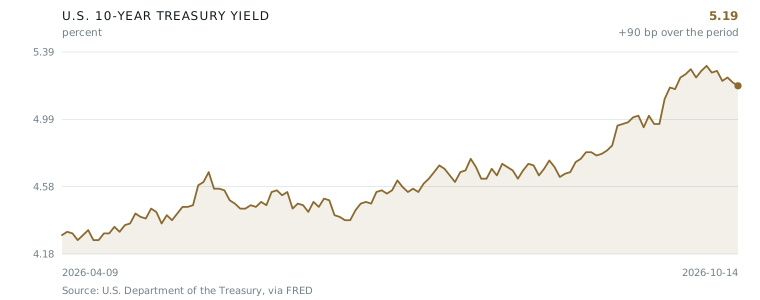
- 01The U.S. 10-year Treasury yield fell to 5.19% on 14 October from 5.21% on 13 October.
- 02European equity markets were reported higher on 15 October despite technology-sector weakness.
- 03Falling bond yields were reported to have offset the tech selloff.
- 04Mario Draghi said inflation is the priority for the ECB and U.S. debt poses a risk.
- 05An 8 October report said bond-spread anxiety was not attributable to Italy.
Interpretation, not reporting. The facts above carry their tiers; this is one correspondent’s reading of them.
The market is borrowing comfort from a very small rate move. I would not treat the shift from 5.21% to 5.19% as evidence that the bond market has turned friendly; it only shows that rates did not worsen while tech weakness hit European equities. Draghi's remarks complicate the mood because inflation-first language cuts against the idea that easing can be assumed, while his warning on U.S. debt reminds holders of long-dated assets that the risk is not contained. The 8 October report saying spread anxiety was not attributable to Italy helps, but it is a week old by the time the equity session happens. I would need European equities to stay firm without falling yields, or spreads to widen with Italy specifically under pressure, to change this reading. Until then, the rally looks tactical rather than convicted.
— Odile Marchetti
Every claim in this article, and what it rests on
We do not ask you to take our word for it. Each statement below carries its tier and its sources. Where sources disagree, you get both accounts and what would settle it.
The U.S. 10-year Treasury yield declined from 5.21% on 13 October 2026 to 5.19% on 14 October 2026.
European equity markets finished higher on 15 October 2026.
Falling bond yields were reported to have offset a technology-sector selloff in European equities on 15 October 2026.
Mario Draghi said on 15 October 2026 that inflation is the priority for the European Central Bank.
Mario Draghi said on 15 October 2026 that debt in the United States poses a risk.
An 8 October 2026 report said anxiety over bond spreads was not attributable to Italy.
The case against this story
Written by an adversarial reviewer, not the correspondent
The story's overall picture leans on two pillars: precise market data showing yields fell, and Mario Draghi's authority backing inflation and U.S.-debt warnings. Both pillars are weaker than presented. The Treasury yield figures are cited to the basis point at the highest confidence tier without any visible primary-source backing, meaning a rounding error could undermine the directional claim. More critically, Draghi left the ECB in 2019; presenting his statements about ECB priorities without naming his current capacity lets readers infer institutional authority he no longer holds. The narrative also casually asserts that bond-spread anxiety was 'not attributable to Italy' based on a single report from a week earlier, which could be outdated or superseded by the time of the 15 October events. Taken together, the story constructs a coherent market narrative—falling yields, tech selloff offset, inflation warnings, U.S. debt risk—but the authority and precision behind its key claims are insufficiently anchored.
Who benefits from this framing: If a reader believes this framing, those who gain are: parties who want Draghi's views to carry ECB-level institutional weight when he no longer holds that office; market participants long European equities who benefit from a narrative that falling yields will continue to support prices; and anyone who wants to deflect concern about Italian bond spreads, since the story explicitly says spread anxiety was 'not attributable to Italy.' Additionally, those advocating for inflation-hawkish policy or U.S. fiscal-discipline messaging benefit from having a globally respected central banker's name attached to those positions, even if he spoke only in a personal or former-official capacity.
Report an error in this article
Subscriptions open at launch
Global Wealth Review will be a paid publication. Reading is free while we build the archive — leave an address and we will write to you once, when subscriptions open.