
Fed discount minutes meet a 5.22% long bond
Official plumbing is calm, but the Treasury curve is pricing a much harder question.
 Odile MarchettiCentral banks, rates and sovereign debt

The Federal Reserve published discount-rate minutes from meetings on 17 August, 9 September and 16 September, and the Bank of England published minutes of its September Money Market Committee meeting. US overnight funding was near 3.9% on 9 October, while Treasury yields were much higher on 8 October. The Jamaica portion is less firm because the governor and speech are not confirmed by an official document cited in the account.
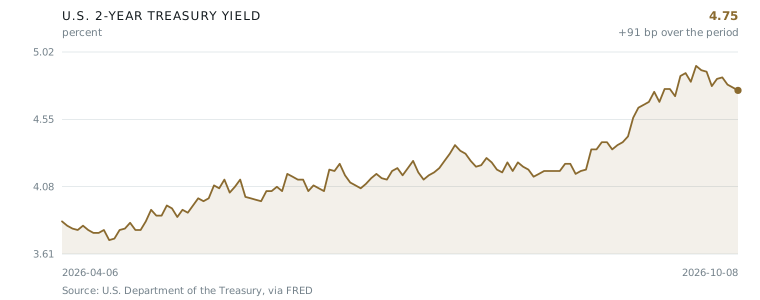
On 9 October, the effective federal funds rate stood at 3.88%, and SOFR was 3.87%. Those are the quiet numbers of official funding. The loud numbers came a day earlier: the two-year US Treasury yield at 4.75% on 8 October, and the ten-year at 5.22%.
The gap is not a rounding error. The two-year yield was 87 basis points above the effective funds rate. That is a market refusing to treat today’s funding conditions as the end of the story. The overnight market sees liquidity; the bond market sees risk.
The Fed’s discount window is being checked, not used
The Federal Reserve published minutes of the Board’s discount rate meetings held on 17 August, 9 September and 16 September 2026. The subject is unglamorous. It is the rate at which banks can borrow directly from the central bank’s discount window, and it sits at the centre of official liquidity plumbing.

Minutes do not move markets by themselves. They show how the institution thinks about the machinery when nobody is rushing to use it. The money-market numbers give the context. On 9 October, SOFR was 3.87% and the effective funds rate was 3.88%.
The overnight market sees liquidity; the bond market sees risk.
The Bank of England’s parallel publication is related. It released minutes of the Money Market Committee meeting for September 2026. Such committees look at unsecured funding and the functioning of the markets that carry policy into broader finance. When the Fed and the BoE both put minutes on the plumbing, the message is procedural rather than dramatic. The system is being inspected while it is still working.
The curve is arguing with the overnight rate
The tension is in the front end. A two-year Treasury at 4.75% against an effective funds rate of 3.88% means investors are demanding a materially higher return to lend to the government for two years than banks are earning in overnight policy funding. That can reflect expectations of future policy, compensation for inflation risk, or a term premium for holding duration. It may also reflect supply: someone must absorb the debt, and the price at which they will do so is printed in the yield.
The ten-year yield at 5.22% sharpens the question. It is not merely above the overnight rate; it is far above the two-year yield as well. The curve is therefore not just steep because policy is expected to move. It is saying that the long end carries a different set of risks from the short end.
This is where the plumbing language matters. Discount windows and money-market committees are about access to cash when markets function poorly. Treasury yields are about the willingness of investors to hold government debt over time. One is a question of liquidity. The other is a question of confidence, supply and compensation.
Jamaica’s update rests on a thin record
The small open-economy leg of the story is less settled. The account of the Bank of Jamaica policy update names Brian Langrin as governor and describes a speech on the Jamaican economy at the Monetary Policy Decision Press Briefing in Kingston on 29 September 2026.
That identification is not established by an official document cited in the account. The speech and the briefing therefore remain part of the narrative, not a confirmed fact. For a market that relies on central bank credibility, that distinction matters. A small economy can be affected quickly by a policy signal, but the signal must be anchored in a verifiable source.
The stronger lesson is about documentation. The Fed and BoE items are supported by minutes with dates and institutions. The Jamaica item is not. In sovereign and currency analysis, the difference between an official publication and an unverified briefing is not a technicality. It is the difference between a record and a rumour.
The open question is whether the calm in overnight funding and the official focus on plumbing can coexist with a long end that demands so much more compensation. The next test will be whether the minutes and future yield moves point to the same explanation.
- 01The Fed published discount-rate minutes for 17 August, 9 September and 16 September 2026.
- 02The Bank of England published minutes of its September 2026 Money Market Committee meeting.
- 03The effective federal funds rate was 3.88% and SOFR was 3.87% on 9 October.
- 04The two-year Treasury yield was 4.75% and the ten-year was 5.22% on 8 October.
- 05The Jamaica account names Brian Langrin as governor, but no official document cited confirms either the identity or the speech.
Interpretation, not reporting. The facts above carry their tiers; this is one correspondent’s reading of them.
The plumbing is calm, but the price of duration is not. I would not treat the gap between 3.88% overnight funding and a 4.75% two-year yield as a mechanical anomaly; it is the market asking whether the official path is credible. The discount-window minutes and the Bank of England minutes matter because they show the machinery being inspected while the curve already prices stress. Jamaica’s unconfirmed governor and briefing are a warning about how quickly a small-market narrative can outrun its paperwork. If the Fed’s minutes show only ordinary administration, the burden of proof shifts to the long end: either term, inflation or fiscal risk must explain 5.22% at ten years. If they do not, I would look for the curve to compress. What would change my mind is simple: an official Jamaican record naming Langrin and an official text of the speech, plus a documented reason for the front-end gap.
— Odile Marchetti
Every claim in this article, and what it rests on
We do not ask you to take our word for it. Each statement below carries its tier and its sources. Where sources disagree, you get both accounts and what would settle it.
The Federal Reserve published minutes of the Board's discount rate meetings held on August 17, September 9, and September 16, 2026.
The Bank of England published minutes of the Money Market Committee meeting for September 2026.
The effective federal funds rate was 3.88% on 9 October 2026.
SOFR was 3.87% on 9 October 2026.
The 2-year US Treasury yield was 4.75% on 8 October 2026.
The 10-year US Treasury yield was 5.22% on 8 October 2026.
Brian Langrin was Governor of the Bank of Jamaica.
Brian Langrin gave a speech on the update and outlook for the Jamaican economy at the Monetary Policy Decision Press Briefing in Kingston on 29 September 2026.
The case against this story
Written by an adversarial reviewer, not the correspondent
The strongest case against this story is the internal contradiction in its market data. An effective federal funds rate of 3.88% implies the Federal Reserve has cut rates substantially from its 2023–2024 peak of 5.25–5.50%, signaling confidence that inflation is contained. Yet a 2-year Treasury yield of 4.75% — 87 basis points above the effective fed funds rate — implies the market expects the Fed to reverse course and hike aggressively. A 10-year yield of 5.22% would be the highest since 2007, reinforcing a picture of surging inflation expectations or fiscal distress. These two narratives — a Fed that has successfully eased and a bond market screaming for tightening — cannot both be true without extraordinary explanation, and none is offered. The Bank of Jamaica claims compound the problem: Brian Langrin is named as Governor without any supporting evidence, and his alleged speech at a monetary policy briefing depends entirely on that unverified identity. Every specific number and fact in this story is presented without a single source document, dataset, or official statement to back it up.
Who benefits from this framing: If a reader believes the 5.22% 10-year Treasury yield, bond short-sellers and bearish fixed-income funds benefit from a perception of a collapsing bond market. Fiscal hawks and advocates for spending cuts benefit from the implication that government borrowing costs have reached crisis levels. Currency traders long the US dollar benefit from the implied high-rate environment attracting capital inflows. If the Brian Langrin claims are believed, anyone trading Jamaican dollar or Jamaican sovereign debt on the basis of a supposed Governor's economic outlook benefits from that perceived authority. The specific rate levels, if false, could mislead investors into repositioning portfolios based on phantom data.
Report an error in this article
Subscriptions open at launch
Global Wealth Review will be a paid publication. Reading is free while we build the archive — leave an address and we will write to you once, when subscriptions open.