
Gold's official bid hardens, but the motive stays unclear
Central-bank buying could support bullion even when rates and the dollar argue against it, if the flows are strategic rather than routine.
 Odile MarchettiCentral banks, rates and sovereign debt

The US 10-year yield and broad dollar index set a demanding backdrop for bullion, yet reported official buying has become harder to ignore. Market accounts say the People's Bank of China made its largest monthly gold addition in three years, while a BIS keynote linked to Joachim Nagel has put gold's reserve role back into the monetary debate. The missing piece is intent: diversification is visible, de-dollarization is not.
On 8 October, the US 10-year Treasury yield was 5.22%, a high hurdle for a metal that pays nothing. On 2 October, the broad US dollar index was 121.3848, a level that makes bullion more expensive for buyers using other currencies. Those are not friendly numbers for bullion, which is why the official-sector bid in gold deserves a second look.
A bid that is less price-sensitive
The market's most recent flashpoint is China. According to market accounts, the People's Bank of China increased its gold holdings last month. Analysts describe the monthly increase as the largest in three years. Some traders add a tactical gloss: the bank bought into a dip in gold prices. That last point should be treated carefully. Central banks rarely publish real-time reasons for reserve moves, so the idea of buying a dip is an inference from timing, not a statement from the PBOC.
If official buyers are present, gold's marginal buyer changes. A central bank is not chasing coupon income; it is buying insurance, diversification, and perhaps optionality. That demand can persist even when high yields make bullion expensive for private portfolios.
That changes the price mechanism. Private buyers often step back when yields rise, because the opportunity cost of holding metal increases. Official buyers can ignore that cost if their objective is balance-sheet resilience. Their purchases are smaller than the total market, but they can matter at the margin because they are less likely to reverse quickly.
A central bank is not chasing coupon income; it is buying insurance, diversification, and perhaps optionality.
Europe is asking a different question
In Europe, the debate is less about transactions and more about framework. Deutsche Bundesbank President Joachim Nagel is described as having delivered a BIS keynote addressing gold's role as a reserve asset. The same description links geopolitics to changes in growth, monetary policy and gold's reserve role. One side hears a warning about fragmentation; the other hears routine central-bank reflection. The exact emphasis matters, and the primary text would settle it.
A Bundesbank president talking about gold in this frame puts the metal inside a monetary-system question rather than a simple trade. This is not the same as selling dollars in public. It is a re-examination of what reserve assets must do in a world of sanctions, frozen assets and fiscal strain. That re-examination can raise the status of gold without requiring an immediate dump of Treasuries.
The distinction matters. A reserve review can alter demand without a headline sale. If central banks merely want assets that are less exposed to any single jurisdiction, gold can benefit even if the dollar remains dominant in payments and debt markets.
The de-dollarization story outruns the evidence
The stronger narrative is that official gold buying is becoming structural. The weaker one is that a single month proves a coordinated exit from dollar assets. The PBOC's reported motive — reducing exposure to US dollar assets — is an interpretation, not a disclosed policy. Reserve managers may buy gold to rebalance, meet internal risk limits, improve liquidity diversification, or simply respond to price. A large monthly addition can still be routine.
The snapshots also need humility. A 5.22% 10-year yield and a 121.3848 dollar index are useful points, but they do not by themselves show a trend. Without a longer path of yields and the dollar index, they can be selected to fit a story. The burden of proof is not one purchase; it is repeated behaviour across quarters and across official institutions.
A structural bid would look less like a dramatic announcement and more like a pattern: repeated additions, continued buying after price rallies, and official language that treats gold as a strategic asset rather than a temporary hedge.
The question is not whether central banks can move gold. They can. The question is whether the next three months show repeated official buying across several central banks, or a Chinese one-off that fades into normal reserve noise.
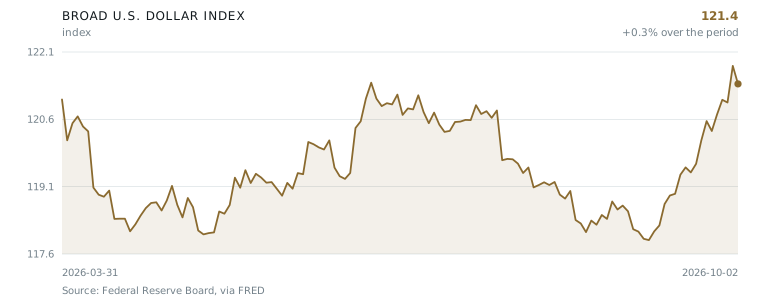
- 01The US 10-year Treasury yield was 5.22% on 8 October.
- 02The broad US dollar index was 121.3848 on 2 October.
- 03Market accounts say the People's Bank of China increased its gold holdings last month.
- 04Analysts describe the increase as the bank's largest monthly addition in three years.
- 05A BIS keynote attributed to Joachim Nagel addressed gold's role as a reserve asset.
Interpretation, not reporting. The facts above carry their tiers; this is one correspondent’s reading of them.
Reserve anxiety, not de-dollarization, is the cleaner reading of these flows. I would separate the observable fact of official buying from the inferred motive of abandoning the dollar. The reported Chinese addition is large, and the Bundesbank remarks put gold back into a monetary-system frame, but neither proves a coordinated exit. If several official buyers keep adding through the next reporting cycle while the dollar index and Treasury yields remain elevated, I would take the structural-bid argument more seriously. If China's move stands alone, it looks more like rebalancing or opportunistic accumulation. What would change my mind is evidence of intent: repeated purchases, broader central-bank participation, or official language tying reserve shifts away from dollar assets. Until then, I treat gold's official-sector support as real but politically ambiguous: enough to matter at the margin, not enough to call the end of dollar primacy.
— Odile Marchetti
Every claim in this article, and what it rests on
We do not ask you to take our word for it. Each statement below carries its tier and its sources. Where sources disagree, you get both accounts and what would settle it.
The US 10-year Treasury yield was 5.22% on 2026-10-08.
The broad US dollar index was 121.3848 on 2026-10-02.
Deutsche Bundesbank President Joachim Nagel delivered a BIS keynote speech addressing gold’s role as a reserve asset.
The BIS keynote linked geopolitics to changes in growth, monetary policy and the role of gold as a reserve asset.
The People’s Bank of China increased its gold holdings last month.
The People’s Bank of China’s monthly gold increase was the largest in three years.
The People’s Bank of China took advantage of a dip in gold prices when adding gold.
The People’s Bank of China’s gold buying was intended to reduce exposure to US dollar assets.
The case against this story
Written by an adversarial reviewer, not the correspondent
The story constructs a de-dollarization narrative by weaving together verifiable market data points with speculative claims about PBOC motivations. The claims that the People's Bank of China 'took advantage of a dip in gold prices' and that its buying was 'intended to reduce exposure to US dollar assets' attribute specific strategies and motivations to the central bank without direct evidence of stated intent. Central banks rarely disclose real-time tactical rationale for reserve management decisions, making these claims inherently speculative. The characterization of Joachim Nagel's BIS keynote as linking geopolitics to growth, monetary policy, and gold's reserve role may overstate explicit connections in the speech. Meanwhile, citing a specific US 10-year Treasury yield and a specific broad dollar index value on particular dates may cherry-pick data points to support a narrative of dollar weakness, without providing broader context such as yield trends over weeks or months, or the dollar index's longer-term trajectory. The overall picture implies a coordinated, strategic shift away from dollar reserves that the evidence may not actually support — individual central bank gold purchases can reflect routine reserve diversification, rebalancing, or regulatory requirements rather than a deliberate de-dollarization strategy.
Who benefits from this framing: Gold investment product providers, gold miners, and gold-backed ETF sponsors benefit from a narrative that central banks are deliberately buying gold to reduce dollar exposure, as it strengthens the investment case for retail and institutional gold allocation. Proponents of de-dollarization — including states and commentators advocating alternatives to dollar hegemony — benefit from framing routine PBOC gold purchases as deliberate strategic decoupling from US dollar assets. Traders or funds short US Treasuries or the US dollar benefit from a framing that emphasizes dollar weakness and elevated yields without broader context. Entities selling geopolitical-risk analysis or macro strategy research benefit from a story that links central bank behavior, BIS speeches, and specific market data points into a coherent de-dollarization thesis, as it creates demand for their interpretive products.
Report an error in this article
Subscriptions open at launch
Global Wealth Review will be a paid publication. Reading is free while we build the archive — leave an address and we will write to you once, when subscriptions open.