
Hong Kong’s China-linked finance push meets soft mainland demand
Green-product trading and a HK$63 billion office project both depend on mainland flows that luxury results now question.
 Odile MarchettiCentral banks, rates and sovereign debt

Hong Kong’s cross-border green-trading milestone arrives as LVMH’s Asia-ex-Japan sales fall raises doubts about mainland demand. A low VIX and a high US 10-year yield show different pressures on risk and funding. Henderson Land’s Central Yards project tests whether premium office demand can fill the gap.
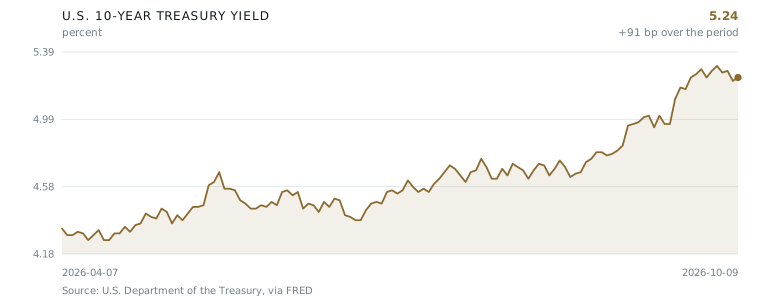
The VIX volatility index closed at 15.21 on 12 October 2026. On 9 October 2026, the US 10-year Treasury yield was 5.24%. Those two numbers sit in the same week but do not describe the same market. One is the price of near-term equity protection. The other is the benchmark cost of long-dated funding.
That split matters for Hong Kong’s effort to draw mainland finance through its exchanges and its office market. The city’s new cross-border green-trading effort needs mainland buyers, while a HK$63 billion office development depends on premium demand. Both are moving against a luxury-goods signal from Asia excluding Japan.
A luxury signal with a wide geography
LVMH said Asia excluding Japan was the only region to suffer falling sales in the third quarter ending September. The company’s update has also been read as showing that sluggish Chinese demand weighed on the quarter. The first point is a direct regional disclosure. The second is an inference.
Asia excluding Japan is not a single economy. It covers many markets, so a fall in that line does not by itself isolate mainland China. If the weakness came from mainland customers, it would support the broader argument that Hong Kong’s China-linked flows face soft demand. If it came elsewhere, the argument is weaker. The LVMH figures therefore raise a question rather than settle it.
What remains unseen is whether mainland flows become broad enough to support both exchange activity and premium Central rents at the same time.
The mechanism is simple. Luxury sales are an early, cash-based gauge of discretionary spending. Office leasing and financial-product trading are slower and more contractual. A soft quarter in luxury does not automatically produce an empty Central tower, but it can point to the same underlying constraint: less appetite from mainland buyers and companies.
HKEX has built the pipes
HKEX says it completed the first cross-border trading of green products under two pilot programmes with mainland Chinese exchanges. That is a plumbing milestone. It connects Hong Kong’s product shelf to mainland venues and creates a route for green assets to move across the boundary.
But a pilot’s first trade is not the same as a durable flow. The channel only matters if mainland investors use it repeatedly, and if issuers find enough demand to justify listing or trading more products. In a weak-demand environment, the first transaction can be real while the follow-on volume remains thin.
This is where the market gauges complicate the picture. A VIX at 15.21 suggests investors are paying little for short-term protection in US equities. A 5.24% 10-year yield suggests long-term money is still expensive. Those signals can coexist: calm in near-term risk appetite does not mean cheap capital for long-dated property or infrastructure-like finance.
Henderson’s HK$63 billion demand bet
Henderson Land Development’s Central Yards project, valued at HK$63 billion, or US$8.03 billion, is presented as relying on premium office demand. The project’s logic rests on tenants and investors willing to pay for top-tier Hong Kong space. That demand is tied to the same China-linked finance push that the exchange pilots are meant to serve.
If mainland demand is merely slow, a premium office project can still lease through the cycle. If the LVMH signal reflects a deeper pullback in Chinese spending and corporate confidence, the pool of tenants able to absorb such space shrinks. The developer’s plan and the luxury-goods warning are therefore not contradictory; they are two claims about the same customer base, tested at different speeds.
The open question is verification. The first green-product trade can be confirmed. The LVMH regional line can be read. What remains unseen is whether mainland flows become broad enough to support both exchange activity and premium Central rents at the same time.
- 01The VIX volatility index closed at 15.21 on 12 October 2026.
- 02The US 10-year Treasury yield was 5.24% on 9 October 2026.
- 03LVMH said Asia excluding Japan was the only region with falling third-quarter sales.
- 04HKEX says it completed the first cross-border green-product trading under two pilots.
- 05Henderson Land’s Central Yards project is valued at HK$63 billion.
Interpretation, not reporting. The facts above carry their tiers; this is one correspondent’s reading of them.
The weak point is attribution, not the existence of soft demand. I can accept that LVMH’s Asia-ex-Japan decline signals trouble for Chinese consumption only if the company ties the fall to mainland customers; otherwise the region is too broad to carry that conclusion alone. Henderson Land’s HK$63 billion Central Yards project looks less like a contradiction than a timing bet: developers commit before demand is proven, while luxury sales reveal consumer weakness quickly. The VIX at 15.21 and the 5.24% 10-year yield do not settle the argument either, because one prices short-term equity calm and the other prices long-term funding. What would change my mind is repetition. If HKEX’s green-product pilots turn into recurring mainland volume, and if Central Yards leasing commitments follow, the soft-demand warning would look early rather than decisive. Until then, the strongest reading is conditional: the pipes are open, but the flow has not yet proved it can pay for premium Hong Kong space.
— Odile Marchetti
Every claim in this article, and what it rests on
We do not ask you to take our word for it. Each statement below carries its tier and its sources. Where sources disagree, you get both accounts and what would settle it.
The VIX volatility index closed at 15.21 on 12 October 2026.
The US 10-year Treasury yield was 5.24% on 9 October 2026.
Sluggish Chinese demand weighed on LVMH in the third quarter ending September.
LVMH said Asia excluding Japan was the only region to suffer falling sales in the third quarter ending September.
HKEX completed the first cross-border trading of green products under two pilot programmes with mainland Chinese exchanges.
Henderson Land Development's Central Yards project is valued at HK$63 billion (US$8.03 billion).
Henderson Land Development is relying on premium office demand to support its Central Yards project.
The case against this story
Written by an adversarial reviewer, not the correspondent
The story's overall picture is internally contradictory. It says sluggish Chinese demand weighed on LVMH and that Asia excluding Japan was the only region with falling sales—but 'Asia excluding Japan' covers many countries, so attributing the decline specifically to 'Chinese demand' is an unsupported leap unless LVMH said so directly. At the same time, the story claims Henderson Land is pouring HK$63 billion into a Central Yards project 'relying on premium office demand'—if Chinese demand is truly sluggish enough to drag LVMH, a massive bet on premium Hong Kong office demand looks reckless, yet the story presents both as straightforward facts without reconciling the tension. The market data deepens the contradiction: a VIX at 15.21 signals market complacency, while a 5.24% 10-year Treasury yield signals significant financial stress—these two numbers paint opposite pictures of market sentiment on the same week. The story cherry-picks data points that individually seem plausible but collectively don't cohere, and it dresses editorial interpretations ('sluggish Chinese demand,' 'relying on premium office demand') as reported facts.
Who benefits from this framing: Readers who accept this framing conclude that Chinese economic weakness is dragging on global luxury sales while Hong Kong simultaneously pursues green-finance innovation and a HK$63 billion property bet. This benefits short sellers of Chinese consumer and Hong Kong property stocks, who gain from a narrative of Chinese weakness and developer overreach. It also benefits competitors of Henderson Land, who gain from skepticism about the Central Yards project's viability. Financial media outlets and commentators benefit from the dramatic contradiction—Chinese weakness alongside a massive Hong Kong property bet—because it generates clicks, trading activity, and demand for further commentary. Policy advocates who want to portray either Chinese decline or Hong Kong resilience also get a ready-made narrative from a story that presents both without reconciling them.
Report an error in this article
Subscriptions open at launch
Global Wealth Review will be a paid publication. Reading is free while we build the archive — leave an address and we will write to you once, when subscriptions open.