
India’s fourth-place ranking meets a 5.21% hurdle
An IMF projection that India becomes the fourth-largest economy in 2027 must be weighed against a 5.21% U.S. Treasury yield and deposit growth with a foreign-currency asterisk.
 Odile MarchettiCentral banks, rates and sovereign debt

The IMF projects India will become the fourth-largest economy in 2027, a ranking that depends on growth, inflation and exchange rates. Record bank deposits of $3 trillion in September add depth, but a dollar deposits scheme helped drive the increase. With the U.S. 10-year Treasury yield at 5.21%, the long-term case is less a straight line than a currency-and-funding test.
On 13 October, the U.S. 10-year Treasury yield stood at 5.21%, a level that raises the appeal of safe dollar assets. An IMF projection, cited by Sud Ouest and Le Temps, projects that India will become the world’s fourth-largest economy in 2027. The two facts sit uncomfortably together. One is a near-term hurdle rate. The other is a long-dated ranking that depends on growth, inflation and, above all, exchange rates.
A ranking that lives in the exchange rate
The IMF projection cited by Sud Ouest has India overtaking Japan for fourth place in 2027. That is not a statement about living standards, productivity or the depth of capital markets; it is a dollar-value comparison of national output. It assumes India’s nominal growth remains strong, Japan’s economy does not reaccelerate, and the rupee does not weaken enough against the dollar to erase the gain. A single depreciation cycle can move the crossover year. So can a yen rally.
Rankings like this are sensitive to the currency in which they are measured. When the dollar strengthens, India’s dollar-denominated GDP shrinks even if domestic activity holds up. The 5.21% yield on the U.S. 10-year Treasury does exactly that work: it supports the dollar, raises the return on safe assets and makes riskier emerging-market claims more expensive to finance. A high U.S. hurdle rate is not a neutral backdrop. It changes the cost of financing growth and the currency math behind the ranking.
The tension is between the long story and the short price.
This is why the forecast should be read as a scenario, not a destination. Assumptions can change. Japan’s dollar GDP can move with the yen. India’s growth can be real and still fail to deliver the crossover in 2027 if the rupee moves the wrong way.
Record deposits carry a foreign-currency asterisk
India’s bank deposits hit a record $3 trillion in September. That is a large pool by any measure, and it suggests a financial system that can absorb more domestic savings. But the record increase was boosted by a dollar deposits scheme. The detail matters. If banks need a foreign-currency incentive to gather funds, the deposit base may be less organically deep than the headline number implies.
Deposit depth is not just a number; it is a source of stability for banks and a signal about household confidence. A scheme-driven surge can reverse when the incentive ends or when the dollar route becomes less attractive. It also raises a question about the mix of money: are these rupees saved by Indian households, or dollars attracted by a specific window? The answer changes how durable the funding is.
Patient capital is not indifferent capital
Live Mint reported that patient capital still sees opportunity in India. The word “still” is doing work. It acknowledges doubts in the market while arguing that long-horizon investors are not leaving. “Patient” also concedes that returns may be slow, uneven or dependent on waiting through cycles. That is a different posture from chasing a headline ranking.
The tension is between the long story and the short price. The IMF projection points to scale: a larger economy, more deposits, more potential for domestic finance. The 5.21% U.S. Treasury yield points to discipline: capital can wait, and it will demand compensation for currency risk, inflation risk and policy risk. The ranking can be read as a direction of travel, not a guarantee.
The question is not whether India can become the fourth-largest economy on one measure. It is whether the deposit base, the exchange rate and the cost of foreign money can stay aligned long enough for that ranking to matter to balance sheets.
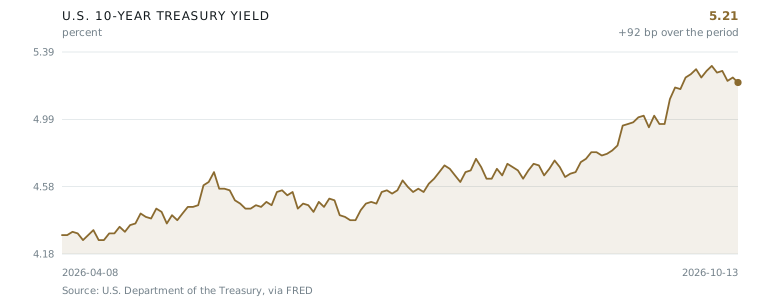
- 01The U.S. 10-year Treasury yield was 5.21% on 13 October.
- 02The IMF projects India will become the fourth-largest economy in 2027.
- 03The projection cited by Sud Ouest has India overtaking Japan.
- 04India’s bank deposits hit a record $3 trillion in September.
- 05A dollar deposits scheme boosted the record deposit increase.
Interpretation, not reporting. The facts above carry their tiers; this is one correspondent’s reading of them.
The crossover is a currency problem before it is a growth story. I can see why patient capital keeps a long file on India: the IMF projection of fourth place in 2027 and $3 trillion of bank deposits point to scale. But the 5.21% U.S. 10-year yield is not background noise. It raises the dollar cost of waiting, supports the currency that measures the ranking, and makes safe assets a serious competitor for risky, long-dated exposure. The dollar deposits scheme also tempers the deposit headline, because an incentive-driven surge may be less sticky than organic savings. I would treat the ranking as a scenario until the funding mix looks less dependent on special windows and the exchange-rate math becomes friendlier. I would change my mind if deposit growth stayed strong after the scheme’s effect faded and if the yield backdrop eased without worsening the currency math. Until then, the story is about patience being tested, not rewarded automatically.
— Odile Marchetti
Every claim in this article, and what it rests on
We do not ask you to take our word for it. Each statement below carries its tier and its sources. Where sources disagree, you get both accounts and what would settle it.
The U.S. 10-year Treasury yield was 5.21% on 2026-10-13.
The IMF projects that India will become the world's fourth-largest economy in 2027.
The IMF projection cited by Sud Ouest has India overtaking Japan for the fourth-largest economy ranking in 2027.
India's bank deposits hit a record $3 trillion in September.
A dollar deposits scheme boosted the record increase in India's bank deposits.
Live Mint reported that patient capital still sees opportunity in India.
The case against this story
Written by an adversarial reviewer, not the correspondent
The story frames India's economic rise as inevitable and broadly positive, but several elements undercut this. The IMF projection that India becomes the fourth-largest economy in 2027 is a forecast, not a fact—it depends on assumptions about growth, exchange rates, and inflation that the IMF revises every quarter, and a single rupee depreciation or yen appreciation cycle could shift the crossover year by several years. The claim that India overtakes Japan specifically assumes Japan's economy stagnates and the yen stays weak; either could change. The U.S. 10-year Treasury yield at 5.21% actually cuts against the bullish India narrative: yields that high on the world's safest asset typically draw capital away from emerging markets, strengthen the dollar (which shrinks India's GDP in dollar terms and makes the overtaking harder), and raise borrowing costs for developing economies. Record bank deposits boosted by a dollar deposits scheme may signal that domestic deposit growth is weak enough to require foreign-currency incentives—hardly a sign of organic financial deepening. And the report that patient capital still sees opportunity is deliberately hedged: 'still' implies prevailing doubts, and 'patient' concedes that returns may be slow or uncertain. Taken together, the story cherry-picks one bullish projection and one high safe-haven yield without reconciling the tension between them.
Who benefits from this framing: The Indian government and its economic policymakers benefit from a narrative of inevitable ascent to fourth-largest economy, which bolsters domestic legitimacy and international bargaining power. Investment managers and funds selling India-focused products benefit from positive framing that attracts retail and institutional capital into their vehicles. Media outlets benefit from click-generating bullish economic stories. The framing also benefits anyone raising capital in or for India, since a reader who believes India is on a predetermined upward trajectory is less likely to scrutinise specific risks—currency exposure, political instability, or the possibility that high U.S. yields pull capital away from emerging markets entirely.
Report an error in this article
Subscriptions open at launch
Global Wealth Review will be a paid publication. Reading is free while we build the archive — leave an address and we will write to you once, when subscriptions open.