
Market utilities are being told to absorb losses, not just avoid them
ECB resilience remarks and BIS guidance on FMI business losses move operational resilience into capital and contingency planning.
 Odile MarchettiCentral banks, rates and sovereign debt

Two publications dated 14 October put market-infrastructure resilience into sharper supervisory focus. The ECB released a speech by Frank Elderson titled Ensuring resilience in the face of uncertainty, while the BIS announced a final report on guidance for FMIs on general business risks and general business losses. The market backdrop is unsettled: long-dated US yields were high relative to policy rates, while the VIX closed low.
Frank Elderson's speech is dated 14 October. On the same day, the Bank for International Settlements issued a media release saying global standard-setting bodies had published a final report on guidance for financial market infrastructures on general business risks and general business losses. The ECB published the speech under the title Ensuring resilience in the face of uncertainty. The BIS release identifies the Bank for International Settlements' Committee on Payments and Market Infrastructures as involved in the final report.
Resilience becomes a balance-sheet question
The two texts arrive separately, but they point at the same operational point. A financial market infrastructure is not only a set of rules for matching, clearing or settling trades. It is also a business with revenue, capital, technology and counterparties. General business risks and general business losses therefore sit close to the institution's own capacity to keep going.
For banks and market utilities, that moves the conversation beyond the familiar question of member default. Default rules ask what happens when a participant fails. Business-loss guidance asks what happens when the utility itself suffers a shock to earnings, capital or continuity. The difference matters because the first can be mutualised among participants, while the second can press directly on the operator's balance sheet and on the supervisors responsible for it.
The ECB's language reinforces that shift. Ensuring resilience in the face of uncertainty is not a phrase about normal markets. It is a phrase about shocks that are hard to specify in advance. When a supervisor uses that framing, the natural follow-through is stress testing, capital adequacy and recovery planning.
The open question is whether the low VIX or the high long yields better describes the risk environment supervisors now expect FMIs to withstand.
The rate backdrop is not quiet
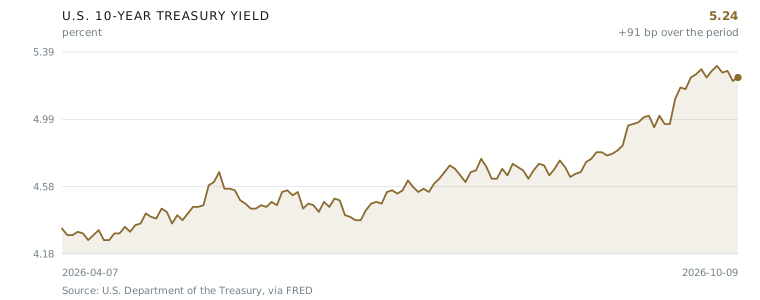
The market numbers attached to this story are not simple background. On 9 October, the 10-year US Treasury yield was 5.24%. The 2-year yield was 4.80%. The effective federal funds rate was 3.88%, and SOFR was 3.87%.
Those figures create wide gaps. The 2-year yield stood 92 basis points above the effective federal funds rate. The 10-year yield stood 136 basis points above the same policy rate and 44 basis points above the 2-year. SOFR was only one basis point below the effective federal funds rate, which is the sort of alignment one expects in money markets.
The longer-dated gaps are the harder part. A 10-year Treasury at 5.24% raises the hurdle for collateral values, funding costs and discount rates across the financial system. For an FMI, that can matter through the quality and liquidity of collateral posted by participants, through the cost of any credit lines, and through the assumptions used in recovery and wind-down planning. A bank holding long-dated debt or providing liquidity to market utilities feels the same arithmetic in its own portfolio.
Then there is the volatility gauge. The VIX closed at 15.21 on 12 October. That is a low number beside a 10-year yield above 5% and a 2-year yield nearly a full percentage point above the policy rate. The data also come from different dates: the Treasury and policy-rate figures are from 9 October, while the VIX close is from 12 October. That does not resolve the tension. It makes the reader ask which signal is doing the work: the calm in equity volatility, or the demand for compensation in longer-dated government debt.
The figures invite skepticism. A low volatility reading beside high long-dated yields can mean that one market is calm, that the dates matter, or that the signals are not being read from the same risk environment. The figures themselves do not resolve that.
The loss-absorption question becomes explicit
The practical consequence is that supervisors now have a final global reference point for asking how FMIs absorb general business losses. The guidance is aimed at FMIs, but banks are not bystanders. They are members, liquidity providers, custodians and sometimes owners of market utilities. If utilities need more capital, clearer recovery tools or stronger controls against business losses, banks will meet those changes in pricing, documentation and collateral demands.
The sequence also matters. Standard-setting reports do not become law on the day they are published. They become expectations through national rulemaking, supervision and examination. But once global bodies issue final guidance, supervisors can point to it when asking how an institution would survive a business shock rather than a member default alone.
The open question is whether the low VIX or the high long yields better describes the risk environment supervisors now expect FMIs to withstand.
- 01The ECB published a speech by Frank Elderson titled Ensuring resilience in the face of uncertainty dated 14 October 2026.
- 02The BIS announced a final report on guidance for FMIs on general business risks and general business losses.
- 03The BIS release identifies the Committee on Payments and Market Infrastructures as involved.
- 04On 9 October, the 10-year Treasury yield was 5.24%, the 2-year was 4.80%, EFFR was 3.88% and SOFR was 3.87%.
- 05The VIX closed at 15.21 on 12 October.
Interpretation, not reporting. The facts above carry their tiers; this is one correspondent’s reading of them.
The supervisory message is less about wording than about where losses land. The ECB’s resilience speech and the BIS final report on FMI general business risks move the debate from participant default to the utility’s own capital and continuity. That matters because a market utility can survive a participant failure with rules and pooled resources, but a business-loss shock presses on the operator itself. The market backdrop makes this uncomfortable: a 10-year Treasury at 5.24% and a 2-year at 4.80% sit far above an effective federal funds rate of 3.88%, while the VIX closed at 15.21. I would not treat those signals as mutually exclusive; they can reflect different dates or different markets. But if the VIX stays low while long yields remain elevated, I would expect supervisors to lean on the bond market’s version of risk. If long yields fall back toward policy rates, the urgency would look less compelling.
— Odile Marchetti
Every claim in this article, and what it rests on
We do not ask you to take our word for it. Each statement below carries its tier and its sources. Where sources disagree, you get both accounts and what would settle it.
The ECB published a speech by Frank Elderson titled Ensuring resilience in the face of uncertainty dated 14 October 2026.
BIS published a media release on 14 October 2026 announcing that global standard-setting bodies issued a final report on guidance for FMIs on general business risks and general business losses.
The BIS media release identifies the Bank for International Settlements’ Committee on Payments and Market Infrastructures as involved in the final report.
The VIX close was 15.21 on 12 October 2026.
The 10-year US Treasury yield was 5.24% on 9 October 2026.
The 2-year US Treasury yield was 4.80% on 9 October 2026.
The effective federal funds rate was 3.88% on 9 October 2026.
SOFR was 3.87% on 9 October 2026.
The case against this story
Written by an adversarial reviewer, not the correspondent
The market data in this story is internally inconsistent. The 2-year Treasury yield at 4.80% alongside an effective federal funds rate of 3.88% creates a 92 basis point spread — a level virtually unheard of in normal market conditions. This spread implies the market expects the Fed to reverse course and hike rates by roughly 100 basis points, yet the VIX at 15.21 signals extreme complacency. These two signals are mutually contradictory: if the market truly expected a dramatic policy reversal, volatility would be elevated, not suppressed. Meanwhile, the 10-year Treasury at 5.24% with the Fed at 3.88% produces a 136 basis point term premium, a level historically associated with significant economic uncertainty — again inconsistent with a VIX near 15. Either the Treasury yield figures or the VIX/fed funds figures are misstated, or data from different dates or sources has been incorrectly aligned. The simultaneous publication of an ECB speech on 'ensuring resilience in the face of uncertainty' and a BIS final report on FMI general business risks on the same day may be coincidental, but together with the inconsistent market data, they construct a narrative of regulatory urgency against a backdrop of market complacency that may not reflect actual conditions.
Who benefits from this framing: If a reader accepts this framing — regulatory leaders warning about resilience while markets appear complacent (VIX 15.21) despite elevated Treasury yields (10-year at 5.24%) — it benefits those advocating for stricter regulation of financial market infrastructures, as the BIS final report on FMI general business risks gains political urgency. It also benefits those arguing that the Fed's rate cuts to 3.88% have failed to transmit to market rates, undermining confidence in monetary policy effectiveness. Finally, it benefits any party that profits from a narrative of hidden systemic risk: if investors believe markets are dangerously calm while regulators sound alarms, they may shift assets toward 'safe haven' products, purchase protection they would not otherwise buy, or support more aggressive supervisory intervention than conditions warrant.
Report an error in this article
Subscriptions open at launch
Global Wealth Review will be a paid publication. Reading is free while we build the archive — leave an address and we will write to you once, when subscriptions open.