
Prime offices and a Tokyo disclosure report test property risk
A reported buyer-nationality rule in Japan could chill cross-border capital while investors split offices into winners and leftovers.
 Samuel AdeyemiPrivate markets and family capital

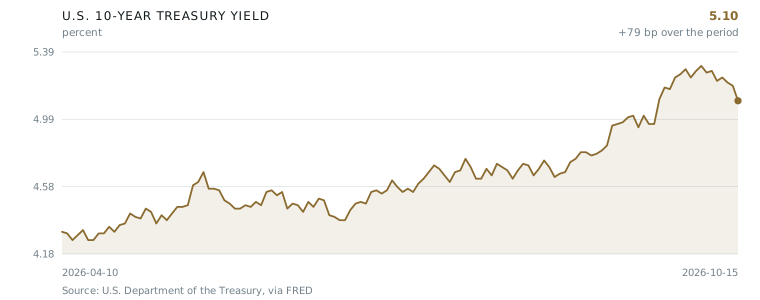
The 10-year US Treasury yield was 5.10% on 15 October, and the VIX closed at 16.46, giving property investors a high rate hurdle and a calm surface. Investor accounts describe offices splitting into prime space and the rest, with tenants competing for the best buildings. A reported Tokyo buyer-nationality disclosure rule raises a separate question: will cross-border capital become more cautious?
On 15 October, the US 10-year Treasury yield was 5.10%, and the VIX closed at 16.46. That combination matters for property: a high long-rate sets the hurdle for any asset that must offer a yield premium, while the volatility print suggests no forced-selling panic.
The same day, the effective federal funds rate was 3.88%, and the Secured Overnight Financing Rate was 3.89%. SOFR is only one basis point above the effective funds rate, while the 10-year sits 122 basis points above that policy level. For real estate, that gap is the trade: financing can be priced, but duration risk remains with the owner.
Long rates are doing the sorting
A 5.10% Treasury yield does not simply make borrowing dearer. It changes the marginal buyer's arithmetic. A prime office tower with long leases and credit tenants can still clear a return hurdle because scarcity gives it pricing power. A secondary building needs a discount, more capital expenditure, or both.

Investor accounts now describe office assets as divided into 'the best and the rest.' In that version of the market, tenants from Hong Kong to New York are competing for space in prime buildings, while older or less central stock is left to negotiate. If those accounts are right, the bifurcation is not a cyclical mood; it is a structural split in who can obtain finance and who can attract tenants.
Until that is answered, the market's likely assumption is that scarcity commands a premium and everything else requires a discount.
The mechanism works through leasing and debt at the same time. Prime space can support refinancing because lenders can underwrite cash flow. Secondary space faces a harder test: shorter leases, more incentives, and more doubt about terminal value. Even a calm VIX does not remove that split. It only means the market has time to make the distinction carefully.
Tokyo's disclosure report is the wildcard
The more fragile part of the story is Japan. One account says Tokyo has implemented a property-purchase disclosure rule requiring all buyers to declare their nationality. The same account says investors are concerned that the requirement may curb foreign investment.
If the rule exists as described, it would add another layer of visibility to foreign buyers. Foreign buyers already face currency, legal, and exit risk. Visibility can change behaviour even before any enforcement action.
The channel is not dramatic. It works through compliance departments, investment committees, and sellers wondering which bids will remain standing. A buyer that must declare nationality may think twice about a market where the political temperature could shift. A seller may discount the pool of likely bidders. At the margin, that can widen the gap between assets that are globally marketable and assets that are not.
The marginal buyer is pickier
For cross-border capital, the question is not whether Tokyo property is desirable. It is whether the buyer can be confident about the rules of ownership, resale, and disclosure. If the reported rule exists as described, it would land at a moment when investors are already separating liquid prime assets from secondary stock.
The rate backdrop reinforces that caution. With SOFR at 3.89% and the effective federal funds rate at 3.88%, money markets show little stress. But the 10-year yield at 5.10% reminds buyers that long-duration assets carry a price for uncertainty. In property, uncertainty shows up in underwriting: lease length, tenant credit, building quality, and the ability to exit.
The open question is whether the reported Tokyo disclosure requirement proves to be a technical formality or a signal of tougher treatment for foreign capital. Until that is answered, the market's likely assumption is that scarcity commands a premium and everything else requires a discount.
- 01The VIX closed at 16.46 on 15 October 2026.
- 02The US 10-year Treasury yield was 5.10% on the same day.
- 03The effective federal funds rate was 3.88%, and SOFR was 3.89%.
- 04Investor accounts say office assets are divided into the best and the rest.
- 05One account says Tokyo has a property-buyer nationality disclosure rule.
Interpretation, not reporting. The facts above carry their tiers; this is one correspondent’s reading of them.
The rate spread is the cleaner signal. I can see why investors would sort offices into the best and the rest when the 10-year Treasury is at 5.10% and the effective federal funds rate is 3.88%. Prime buildings can underwrite that hurdle; secondary buildings need a discount. The Tokyo disclosure report is harder to use, because it arrives as a market account. Still, if buyers really must declare nationality, the effect would run through process and confidence rather than headline demand. Foreign capital does not need a ban to become cautious; it only needs extra visibility, extra compliance, and extra doubt about the next rule. My test would be simple: if prime cross-border bidding stays deep while secondary assets widen, the disclosure is a nuisance. If prime deals also thin, the rule is doing real work. Until then, the market's likely posture is to pay for scarcity and charge for opacity.
— Samuel Adeyemi
Every claim in this article, and what it rests on
We do not ask you to take our word for it. Each statement below carries its tier and its sources. Where sources disagree, you get both accounts and what would settle it.
The VIX closed at 16.46 on 15 October 2026.
The US 10-year Treasury yield was 5.10% on 15 October 2026.
The effective federal funds rate was 3.88% on 15 October 2026.
The Secured Overnight Financing Rate was 3.89% on 15 October 2026.
Tokyo has implemented a property-purchase disclosure rule requiring all buyers to declare their nationality.
Investors are concerned that Tokyo’s property-purchase nationality-disclosure rule may curb foreign investment.
Investors now view office assets as divided into the best and the rest.
From Hong Kong to New York, tenants are competing for space in prime office buildings.
The case against this story
Written by an adversarial reviewer, not the correspondent
The story's fundamental weakness is the complete absence of supporting evidence for any of its claims. Specific market data points—the VIX close, the 10-year Treasury yield, the effective federal funds rate, and SOFR—are presented at the highest confidence without any cited data source, feed screenshot, or official publication. The claim that Tokyo has implemented a property-purchase disclosure rule requiring all buyers to declare their nationality is stated as established fact without reference to any government ordinance, ministry announcement, or legal text. The investor-sentiment claims—that office assets are now divided into 'the best and the rest' and that tenants from Hong Kong to New York are competing for prime space—are presented without any survey data, transaction records, leasing-volume figures, or named sources. The story layers verifiable-sounding precise numbers on top of an unverified policy claim and subjective sentiment, creating a veneer of quantitative authority that could make the softer, qualitative claims seem more evidence-backed than they are. A reader cannot independently confirm a single assertion in this story.
Who benefits from this framing: If readers believe this framing, several parties benefit. Owners and developers of prime office assets benefit from the narrative that tenants are competing for prime space and that the office market has bifurcated into 'best and rest,' as this supports prime-asset valuations, rents, and investment-case pitches to limited partners. Domestic Japanese property interests and incumbent landlords benefit if the Tokyo nationality-disclosure rule is accepted as established policy, since it could discourage or slow foreign capital competing for Japanese real estate. Market participants positioned for sustained high long-term rates—bond bears, short-duration investors, or those arguing the Fed cannot bring yields down—benefit if a 5.10% 10-year Treasury yield is accepted without question, as it reinforces expectations of elevated borrowing costs. Storytellers and headline-writers benefit from the dramatic framing of a Tokyo crackdown on foreign buyers paired with a global flight-to-quality in o
Report an error in this article
Subscriptions open at launch
Global Wealth Review will be a paid publication. Reading is free while we build the archive — leave an address and we will write to you once, when subscriptions open.