
SEC crowdfunding review and X purges test market trust
Retail capital rules and platform purges are colliding with an already expensive bond market.
 Odile MarchettiCentral banks, rates and sovereign debt

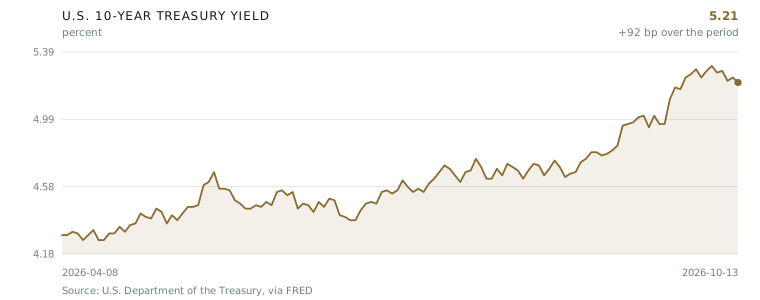
The SEC's Small Business Capital Formation Advisory Committee has announced a meeting linked to IPO modernization and Regulation Crowdfunding. X said it suspended 13,000 accounts it tied to foreign influence ahead of the midterms, a figure that remains self-reported. The 10-year Treasury yield was 5.21% and the VIX 15.27 on 13 October, an uneasy combination.
On 13 October, the US 10-year Treasury yield stood at 5.21%, while the VIX closed at 15.27. Those two numbers do not point in the same direction. One says long-dated funding is expensive enough to strain borrowers, refinancings and public balance sheets. The other says equity options markets expect calm. Into that gap come two governance stories: an SEC advisory-committee meeting on retail capital formation and X's announcement that it suspended 13,000 accounts.
A bond market that already sounds stretched
The 10-year yield at 5.21% matters because it is the benchmark for a wide set of US credit: mortgages, corporate bonds, project finance and the government's own refinancing needs. The 2-year yield was 4.79% on the same day, leaving the curve positively sloped by 42 basis points. That is not an inverted warning in itself. It is a market demanding a high premium for holding duration.
A 5.21% long bond can absorb a lot of news, but it cannot absorb a loss of confidence in the institutions that price risk. When the VIX sits at 15.27, the immediate equity message is not panic. It is that investors are being paid little to brace for shocks. If a governance dispute later forces a repricing of US institutions, the adjustment would start from a calm base, not a panicked one.
A 5.21% long bond can absorb a lot of news, but it cannot absorb a loss of confidence in the institutions that price risk.
The SEC's retail-plumbing question
The SEC's Small Business Capital Formation Advisory Committee has announced a meeting. The session has been linked to IPO modernization and Regulation Crowdfunding, though the formal SEC agenda is the document that will settle exactly what is on the table. Some market participants see a signal that retail capital formation is moving back up the Washington agenda; others argue the committee is simply doing routine work.
The mechanism is unglamorous but important. Regulation Crowdfunding determines how small companies can raise money from non-institutional investors, under what limits and through what intermediaries. IPO modernization touches listing costs, disclosure burdens and the competitiveness of public markets. If rules are loosened, small issuers may find it easier to tap retail money. If safeguards are weakened, retail investors may face more fraud, dilution or illiquid positions. The SEC's choices will show up first in filing volumes, intermediary compliance costs and the quality of disclosures.
This is not a market-moving event on its own. It becomes relevant because retail participation is already a political subject. Ahead of the midterm elections, any change to how ordinary Americans buy risk assets can be framed either as capital-formation reform or as political risk. The bond market does not care about the framing. It cares whether policy noise adds to term premium.
X's purge is a platform problem with a market shadow
X said it suspended 13,000 accounts. The platform alleged that the suspended accounts were linked to foreign influence targeting US political debate ahead of the midterm elections. The number and attribution come from X itself.
For markets, the issue is not whether one platform's moderation decision changes the path of rates. It does not. The issue is whether the information environment around US assets is becoming harder to verify. Investors rely on price discovery, disclosure and a basic shared record of events. When a major platform announces a purge of political influence accounts, the relevant question is governance: who decided, under what evidence, and with what appeal. If the answer remains self-reported, trust becomes another input that bondholders may eventually demand compensation for.
The open question is simpler. The SEC meeting may prove routine. X's suspension figure may remain self-reported. The VIX may stay low while the 10-year yield moves for purely macro reasons. What would change the picture is a visible link: a contested capital-formation rule, an election-integrity dispute and a bond-market repricing arriving together. Until then, the watch items are the SEC's formal agenda, any independent corroboration of X's account suspensions, and whether the 42-basis-point curve steepening becomes a sustained demand for extra term premium.
- 01The SEC's Small Business Capital Formation Advisory Committee announced a meeting.
- 02The meeting has been linked to IPO modernization and Regulation Crowdfunding.
- 03X said it suspended 13,000 accounts over alleged foreign influence.
- 04The US 10-year Treasury yield was 5.21% and the 2-year yield 4.79% on 13 October.
- 05The VIX closed at 15.27 on 13 October.
Interpretation, not reporting. The facts above carry their tiers; this is one correspondent’s reading of them.
The market-integrity risk here is not a single scandal. It is the accumulation of unverifiable governance signals while long-term funding is already expensive. I do not need the SEC meeting to be momentous, or X's 13,000-account figure to be false, for that to matter. A 5.21% 10-year yield and a 4.79% 2-year yield already show investors demanding compensation for duration. A VIX at 15.27 says near-term equity traders are not paying much for protection. That mix leaves little margin for an institutional surprise. If the SEC's formal agenda confirms a serious retail capital-formation overhaul, and if X's suspension numbers gain independent corroboration, the two threads could become a genuine governance premium. If the agenda is routine and the platform purge fades, I would treat this as noise. The bond market will decide which it is.
— Odile Marchetti
Every claim in this article, and what it rests on
We do not ask you to take our word for it. Each statement below carries its tier and its sources. Where sources disagree, you get both accounts and what would settle it.
The SEC’s Small Business Capital Formation Advisory Committee announced it will hold a meeting.
The VIX closed at 15.27 on 2026-10-13.
The US 10-year Treasury yield was 5.21% on 2026-10-13.
The US 2-year Treasury yield was 4.79% on 2026-10-13.
The announced SEC advisory-committee meeting will discuss IPO modernization.
The announced SEC advisory-committee meeting will discuss Regulation Crowdfunding.
X suspended 13,000 accounts.
X alleged the suspended accounts were linked to foreign influence targeting US political debate ahead of the midterm elections.
The case against this story
Written by an adversarial reviewer, not the correspondent
The story bundles three unrelated developments into what reads like a coherent narrative of regulatory response, political manipulation, and market stress — but the connections are manufactured. The SEC Small Business Capital Formation Advisory Committee meets routinely; characterizing its agenda as 'IPO modernization' and 'Regulation Crowdfunding' may be interpretive rather than quoted from any official agenda. X's claim that it suspended 13,000 accounts linked to foreign influence targeting U.S. political debate is self-reported, self-serving, and unverifiable by outside parties — X benefits from appearing to protect democratic processes ahead of midterms, and the specific number and attribution cannot be independently confirmed. The 10-year Treasury yield at 5.21% is economically extraordinary and, if inaccurate or reflecting an intraday spike rather than a close, undermines any narrative built on market stress. Meanwhile, the VIX at 15.27 actually signals low expected market volatility, which sits awkwardly alongside a crisis-adjacent framing. These are three separate stories forced into one frame.
Who benefits from this framing: Financial industry interests benefit from framing routine SEC advisory-committee activity as 'IPO modernization' and 'Regulation Crowdfunding' discussion, which primes the policy conversation toward deregulation of capital-raising rules. X benefits from publicizing foreign-influence account suspensions ahead of midterm elections, positioning itself as a guardian of democratic discourse while providing no independently verifiable evidence. Political actors benefit from the foreign-influence narrative, which can be used to discredit domestic opposition voices as foreign-manipulated. Fiscal hawks and bond bears benefit if readers accept the 5.21% 10-year yield as evidence of a fiscal crisis, strengthening arguments for spending cuts or tighter monetary policy.
Report an error in this article
Subscriptions open at launch
Global Wealth Review will be a paid publication. Reading is free while we build the archive — leave an address and we will write to you once, when subscriptions open.