
Senegal's one-year debt test puts IMF credibility on the clock
Washington's deadline, Kristalina Georgieva's optimism and a 2027 budget make Senegal a benchmark for frontier debt recovery.
 Odile MarchettiCentral banks, rates and sovereign debt

The US wants Senegal's debt restructuring completed within one year, and Kristalina Georgieva said she is rather optimistic about an agreement with creditors. The IMF's warning that Africa's resilience masks rising inflation and fragile buffers sets a harder test for that optimism. Senegal's projected 2027 budget of 7,363 billion FCFA is the fiscal number creditors will watch.
On 13 October, the 10-year US Treasury yield stood at 5.21%, while the two-year note yielded 4.79%. That 42-basis-point gap is a small piece of curve mechanics, but it is also the price of patience for any government trying to stretch repayments. The level matters as much as the shape. At 5.21%, a long-dated US asset offers a high hurdle for investors who can choose between a restructuring claim and a liquid government bond. The higher that hurdle, the less patience creditors may have for long maturities and low coupons. For Senegal, whose debt restructuring Washington wants completed within one year, the risk-free rate is not background noise. It is the hurdle creditors will use to judge every concession.
A one-year deadline is a negotiating weapon
The US wants Senegal's debt restructuring completed within one year. A deadline that tight does two things at once. It forces creditors to show their cards, and it forces the IMF and official lenders to coordinate before positions harden. It also raises the cost of failure: if the clock runs out, the market will assume the official sector cannot hold a sovereign case together.
The same Washington message carries a second, slower instinct. The US Treasury secretary said the IMF should strengthen controls over debtor countries. Stronger controls can improve confidence, but they also add reviews, conditions and paperwork to a process that is being asked to move fast. The tension is not rhetorical. It is operational: one part of the official sector wants speed, while another wants tighter oversight.
Georgieva's optimism meets a fragile African backdrop
Kristalina Georgieva said she is rather optimistic about Senegal's debt situation and an agreement between Senegal and its creditors. That is the language of a deal that officials want to keep alive. It is also the language that markets discount until creditor positions are visible.
The IMF's own regional warning makes the discount harder to ignore. The fund warned that Africa's economic resilience masks a rising inflation threat and fragile buffers. Senegal is part of that Africa. If buffers are thin, a restructuring that only restores solvency on paper will not buy much time. Creditors will ask whether the deal leaves enough foreign exchange, revenue and fiscal space to survive the next shock.
That is where the official sector's push for speed becomes hard to manage. It wants a precedent for coordination, but it is working in a setting where inflation and weak buffers can turn a clean agreement into a repeat problem. Optimism can be a diplomatic register. The market will read it against the fund's warning.
The 2027 budget is the credibility meter
Senegal's projected budget expenditures for 2027 are 7,363 billion FCFA. The figure is precise, but a projection is not cash in hand. In a restructuring, fiscal assumptions move: debt service changes, financing gaps shift, and the state's spending envelope can be redrawn before the year begins. The figure also becomes the common denominator in talks: debt-service savings, new financing and expenditure cuts must all be measured against it.
That makes the 2027 budget the first real test of the one-year deadline. If a deal is signed quickly, it must still fit inside a budget that creditors, the IMF and Senegalese authorities can all defend. If the numbers need to be revised soon after the agreement, the market will conclude that the deadline was political rather than fiscal.
The open question is not whether Washington can name a clock. It is whether the IMF, Senegal and its creditors can make the same clock mean the same thing before 2027 turns from a projection into a constraint.
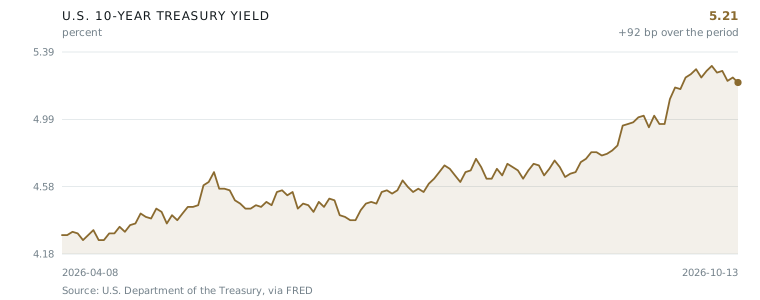
- 01US 10-year Treasury yield was 5.21% on 13 October; two-year was 4.79%.
- 02The US wants Senegal's debt restructuring completed within one year.
- 03Kristalina Georgieva said she is rather optimistic about Senegal's debt and a creditor agreement.
- 04The IMF warned Africa's resilience masks rising inflation and fragile buffers.
- 05Senegal's projected 2027 budget expenditures are 7,363 billion FCFA.
Interpretation, not reporting. The facts above carry their tiers; this is one correspondent’s reading of them.
The one-year deadline is the real instrument. I would treat Washington's push as an attempt to force coordination among creditors before Senegal's 2027 budget becomes a stress test. Kristalina Georgieva's optimism can help that process, but it sits awkwardly beside the IMF's warning that Africa's resilience masks rising inflation and fragile buffers. If those buffers are thin, creditors will demand more than promises; they will want controls that can be verified quickly. The US Treasury secretary's call for stronger IMF controls over debtor countries points the same way, even if it risks slowing the very deal Washington wants. The 7,363 billion FCFA expenditure figure is the point where diplomacy meets arithmetic. A projection can hold a coalition together, but only until the first revision. What would change my mind is a creditor agreement that survives the 2027 budget without immediate budget revision. If that holds through the year, the IMF will have a benchmark. If it slips, the one-year clock will look like pressure without a plan.
— Odile Marchetti
Every claim in this article, and what it rests on
We do not ask you to take our word for it. Each statement below carries its tier and its sources. Where sources disagree, you get both accounts and what would settle it.
The US 10-year Treasury yield was 5.21% and the 2-year yield was 4.79% on 13 October 2026.
Kristalina Georgieva said she is rather optimistic about Senegal's debt situation and an agreement between Senegal and its creditors.
The US wants Senegal's debt restructuring to be completed within one year.
Senegal's projected budget expenditures for 2027 are 7,363 billion FCFA.
The IMF warned that Africa's economic resilience masks a rising inflation threat and fragile buffers.
The US Treasury secretary said the IMF should strengthen controls over debtor countries.
The case against this story
Written by an adversarial reviewer, not the correspondent
The story's overall picture is internally contradictory. It presents the IMF Managing Director as 'rather optimistic' about Senegal's debt situation and an agreement with creditors, while the IMF simultaneously warns that Africa's economic resilience 'masks a rising inflation threat and fragile buffers.' If the IMF's own institutional assessment is that buffers are fragile and inflation is rising, the optimism about Senegal may be diplomatic courtesy rather than substantive confidence — especially since Senegal is part of the Africa the IMF is warning about. The US wanting debt restructuring completed 'within one year' while also pushing for the IMF to 'strengthen controls over debtor countries' sends mixed signals: stronger controls could slow restructuring rather than expedite it, and the two positions may reflect different factions within the US government rather than a coherent policy. The very specific 2027 budget expenditure figure (7,363 billion FCFA) lends false precision to what is inherently a projection subject to revision — particularly for a country actively undergoing debt restructuring, where fiscal assumptions are in flux. The US Treasury yield data appears disconnected from the Senegal and Africa narrative; its inclusion may serve to lend credibility by association rather than adding substantive relevance to the story.
Who benefits from this framing: If readers believe this framing, it primarily benefits Senegal's government and its international creditors. The narrative suggests the debt situation is manageable with active international support — IMF optimism, US engagement for timely restructuring — which reassures investors and markets about Senegal's creditworthiness and discourages panic selling of Senegalese debt. Creditors benefit from the impression that restructuring will be orderly, swift, and internationally supervised, reducing their incentive to offer deeper concessions. The IMF benefits from appearing both supportive and prudent. Financial institutions considering exposure to Senegal or broader African sovereign debt benefit from the impression that risks are acknowledged but under control. The US Treasury benefits from appearing engaged and responsible in pushing for both speed and institutional reform at the IMF.
Report an error in this article
Subscriptions open at launch
Global Wealth Review will be a paid publication. Reading is free while we build the archive — leave an address and we will write to you once, when subscriptions open.