
Warsh speech revives Fed hike watch after hot PPI
A former official’s words may move positioning, but the curve already shows traders bracing for higher rates.
 Odile MarchettiCentral banks, rates and sovereign debt

Kevin Warsh’s speech is being watched for clues on a possible Fed hike this month after a hot PPI print. Short-term rates already sit well above the effective funds rate, while the VIX and dollar suggest positioning rather than panic. The key dispute is whether a former official’s remarks can signal policy or merely amplify an existing market move.
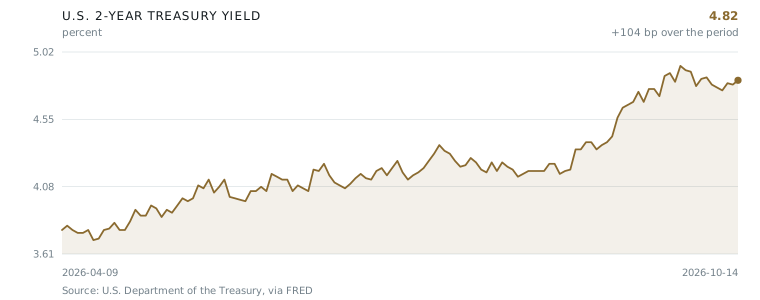
On 14 October, the two-year Treasury yield stood at 4.82%, 94 basis points above the effective federal funds rate, which printed at 3.88%. That gap is the market’s way of saying the next move may still be up.
The speech by Kevin Warsh lands in that gap. Two outlets, NBC News and AOL, have framed it as a possible source of clues on whether the Federal Reserve will raise interest rates this month. That is a heavy load for one former official’s remarks, and the dispute is worth stating plainly. One side treats the speech as a signal because of Warsh’s standing; the other side answers that speeches by former policymakers are commentary, not decisions, and that only the current committee can move the funds rate.
A curve already leaning hawkish
The Treasury market has already done part of the work. The 10-year yield was 5.19% on the same day, 37 basis points above the two-year and 131 basis points above the effective funds rate. An upward-sloping curve of that shape does not prove a hike is coming. It does show investors demanding more compensation for holding longer-dated debt, which is what they do when they fear inflation or supply will keep pressure on rates.
A former official may know the debates, but he does not control the lever.
The equity market is not flashing panic. The VIX closed at 16.87, a calmer reading than the 94-basis-point gap between the two-year and funds rate might suggest. The broad dollar index, at 121.6023 on 9 October, was firm enough to add another tightening channel beside the yield curve. A stronger dollar can tighten financial conditions on its own, but it also reflects demand for dollar assets, which complicates the simple story that higher rates alone are driving the move.
The Warsh question
The case for watching Warsh is not that he speaks for the Fed. It is that markets sometimes use prominent voices to coordinate expectations. If traders believe a speech may hint at a hike, they can move prices in a way that makes financial conditions do some of the central bank’s work. That is why a speech can matter even when the speaker has no vote.
The counterargument is just as simple. A former official may know the debates, but he does not control the lever. If the market is looking for clues, the cleaner evidence would come from current policymakers, official statements, or money-market rates that move before the meeting. Without that, the Warsh angle risks becoming a narrative attached to data that was already pointing higher.
Funding rates deserve a second look
One detail in the short-end data is unusually neat. The effective federal funds rate and the Secured Overnight Financing Rate both printed at 3.88% on 14 October. Those rates come from different markets, so perfect alignment is worth checking rather than assuming. It may reflect rounding, timing, or a stable reserve environment; it does not by itself confirm a policy signal.
The practical question for allocators is whether the producer-price report behind the hike watch and the speech together change the odds of a hike this month. The market has already moved the front end well above the current policy rate. If the Fed does nothing, the two-year yield would need a new reason to stay near 4.82%. If the Fed does hike, the question shifts to whether the long end at 5.19% is high enough to absorb it.
The open issue is whether the speech produces a shared reading, or merely another set of competing interpretations. Watch whether money-market rates move first.
- 01The effective federal funds rate was 3.88% on 14 October.
- 02SOFR printed at the same 3.88% on 14 October.
- 03The two-year Treasury yield was 4.82%; the 10-year was 5.19%.
- 04The VIX closed at 16.87 on 14 October.
- 05The broad dollar index was 121.6023 on 9 October.
Interpretation, not reporting. The facts above carry their tiers; this is one correspondent’s reading of them.
The market is not waiting for Kevin Warsh; it is using him as a hook. The 2-year at 4.82% and 10-year at 5.19% already show investors demanding more yield for longer duration, while the effective funds rate at 3.88% leaves room for another hike if inflation surprises persist. The oddity is that SOFR printed at the same 3.88%, which should make readers ask whether the funding backdrop is being overstated. I would treat any Warsh remarks as commentary unless they are followed by current policymakers or visible desk activity. What would change my mind: a corroborated shift in language from policymakers, or money-market rates moving away from 3.88% before the meeting. Until then, the speech is a catalyst for positioning, not evidence of policy.
— Odile Marchetti
Every claim in this article, and what it rests on
We do not ask you to take our word for it. Each statement below carries its tier and its sources. Where sources disagree, you get both accounts and what would settle it.
The effective federal funds rate was 3.88% on 2026-10-14.
The Secured Overnight Financing Rate was 3.88% on 2026-10-14.
The 2-year Treasury yield reading DGS2 was 4.82 on 2026-10-14.
The 10-year Treasury yield reading DGS10 was 5.19 on 2026-10-14.
The VIX close was 16.87 on 2026-10-14.
The broad dollar index DTWEXBGS was 121.6023 on 2026-10-09.
Kevin Warsh could offer clues about whether the Federal Reserve will raise interest rates.
A Kevin Warsh speech could offer clues about whether the Fed will raise interest rates this month.
The case against this story
Written by an adversarial reviewer, not the correspondent
The story's central premise rests on treating Kevin Warsh as though he has current insider access to Federal Reserve deliberations. Warsh left the Fed Board in 2011; his speeches are market commentary, not policy signals. The claim that he 'could offer clues' about rate decisions is speculative language that could apply to any former official or even any market commentator. Meanwhile, the market data cited — the effective federal funds rate at 3.88%, the 2-year Treasury at 4.82%, the 10-year at 5.19% — shows an upward-sloping yield curve with the market already pricing in higher rates. This reflects broad market expectations, not anything specific to Warsh. The identical 3.88% figures for both the effective federal funds rate and the Secured Overnight Financing Rate are suspicious because these rates are derived from different markets and normally diverge. The VIX at 16.87 and the broad dollar index at 121.60 show moderate volatility and a strong dollar, neither of which specifically validates a Warsh-driven narrative. The story conflates verifiable market data with speculative commentary from a former official, lending unearned authority to the Warsh angle.
Who benefits from this framing: Readers who believe this framing would elevate Kevin Warsh's influence and credibility as a Fed commentator, directly benefiting Warsh himself and any media outlet or financial institution promoting his speeches. Traders who position ahead of Warsh's speech based on this framing could benefit if other market participants follow the same narrative and move prices. The framing also benefits anyone selling Fed-watching research, subscriptions, or trading strategies by creating the impression that a single speech by a former official could meaningfully shift rate expectations.
Report an error in this article
Subscriptions open at launch
Global Wealth Review will be a paid publication. Reading is free while we build the archive — leave an address and we will write to you once, when subscriptions open.